Wednesday, 10 November 2010

The Bowerbird's Bower

Yesterday I went to the gardens for lunch without my camera and I'd never been more frustrated at not having it with me... I had found the Satin Bowerbird's Ptilonorhynchus violaceus bower! I first discovered the mature male Satin Bowerbird in the gardens over a month ago now, and managed to get a picture of him for this blog in early October.  So I rushed back to the gardens as soon as I could at lunchtime today and took some pictures of this amazing structure.  It is about a foot (30cm) high and is a little hidden within some bushes.  The range of blue objects he has found to decorate it are amazing, all the same shade of blue too!  You can see a close up of a peg below.  There was also a couple of pretty yellow flowers I think he might have also put there.  Incredible.


I wonder what the Satin Bowerbird would have used before blue plastic was invented?
In my rush to get to the gardens I hadn't really noted what the weather was looking like and as soon as I had taken the pictures of the bower the heavens opened.  Its been so wet in Canberra recently, though now its heating up its starting to feel more like tropical than English rain, but there is plenty of it!  So I made a dash for a shelter nearby and ate my lunch there, amusing myself by taking pictures of raindrops falling on the shelter and on some leaves. 


Once the rain stopped I carried on wandering in the gardens.  The water dragons appeared again after the rain and nearby I noticed the huge Gymea Lily Doryanthes excelsa is starting to flower, it will be spectacular in a few days or so when it is in full bloom.  I also noticed there seems to be a new trail through the gardens that must alter weekly, called the 'In flower this week walk', what a great idea!


There was a little sign about the Aboriginal use of the Gymea flower next to it in the garden: The Gymea flowering stem grows up to 4 metres high, but it was roasted and eaten when it is only about 0.5 metres high and as thick as a man's arm.  The roots were also roasted and made into a sort of cake.  The name 'Gymea' comes from the Wodi Wodi tribe of the Illawarrra district near Sydney.  

Tuesday, 2 November 2010

Tango in the gardens

There is a great event on at the Gardens on Sunday, a Tango concert with some Argentinian musicians and youth music in Canberra: More details here

My partner Edd and I are Tango dancers, but unfortunately we won't be able to go to this event as I will be dancing Flamenco - we have a great Flamenco artist coming to Canberra to give some workshops, Paloma Gomez, an unmissable opportunity.

If you are curious about the beautiful music of Tango and this most romantic of dances do go along and see what its all about!  Here is a picture of Edd and I dancing (taken in Sydney earlier in the year).  I love this picture as it captures some of the romance and mystery of Tango:

Monday, 25 October 2010

The Dragons are back - but no sign of the Gang-gangs

On Wednesday the garden was full of Gang-gang cockatoos Callocephalon fimbriatum - I could hear them everywhere and saw about 10 of them.  I even saw a pair doing a sort of mating dance, where they gave each other little pecks.  Of course, when I went back on Friday with my camera there wasn't one to be seen, so I still haven't got a picture of one for my blog!  They seemed to have been replaced by Crimson Rosellas - and love was in the air for these too.  The Pryor tree has a pair nesting in a hole, I got a very cute picture of one peeking out, I thought I saw a little one beside her too at one point, but I might have imagined it!


To make up for the lack of Gang-gangs I was pleased to find plenty of Water Dragons back in the gardens, the last time I saw one to take a picture of for this blog was for my second blog post, back in March! I saw a small one too - it looks like its a baby dragon. 


 After seeing so many Waratahs last weekend at Mount Tomah I remembered the picture I took earlier in the year (April) of a Braidwood Waratah seedpod (Telopea mongaensis).  I found the plant again and it was bursting into bloom, some seedpods are still clinging on though you can just see in the first picture. 
 I found a couple more pretty flowers I'd not seen before too, a beautiful Orchid Telychiton tarberi at the entrance to the Rainforest, which is an epiphyte (attaches itself to the trunk of trees).  This appears to be referred to commonly as 'king orchid' which I can see why, its quite spectacular. 

I also found this beautiful purple flower in the Grevillea/Hakea section, it looks more like a Hakea to me but I couldn't find a label on it. 

Friday, 22 October 2010

ANBG 40th Anniversary - celebrations this week


This week the Australian National Botanic Gardens is celebrating its 40th anniversary.  On Sunday numerous events will be held in the gardens. In conjunction with this event, the herbarium will have an Open Day this Sunday from 10-4 with guided tours on the hour.  The ANBG will be displaying some of their botanical collections and research.  There will be a shuttle bus between the herbarium and numerous sites within the gardens.

Sunday 24 October – 10am – 4pm
40th Anniversary Open Day and Garden Party   

Full program here (pdf)
·            Main stage Live music and entertainment from 10 – 4pm
·            Children activities from 10am – 4pm
·            The Friends of the Garden cake cutting to at 11am
·            High Tea party in the Eucalypts Lawn
·            Botanic fashion parade and fascinator competition 
·            Continuous garden bus shuttles/tours
·            Behind the scene tours  10- 4pm
·            Market stalls, fashion parade and fascinator competition.
·            666 ABC Canberra Outside Broadcast – with Greg and Willow 10- 12  

Tuesday, 19 October 2010

An adventure at magical Mount Tomah

Mount Tomah is Australia's Mountain Garden, located 1000m above sea level in the northern Blue Mountains.  We were over that way at the weekend so thought we should pay it a visit - it was a glorious sunny spring day (though the day before had been snow flurries!).  Well, it was simply magical.  A small wedding was taking place there that day (you can just make out the bridal party in one of the landscape pictures below) and the whole place was just alive with millions of spring flowers: Waratahs, Rhododendrons and even bluebells! There were some exotic plants there too, such as the beautiful 'magic flower' or 'sacred-flower-of-the-incas'.  All around was the distinctive sound of the Whip-bird and Kookaburra in the trees as the odd lizard scuttled amongst the rocks.  The air was fresh but the sun was warm.  From a viewpoint in the Gondwana woodland we could see Sydney in the distance, a world away. 

Tuesday, 12 October 2010

Bowerbirds and an empty nest

An empty nest!  The baby Red Wattlebirds I've been visiting for the past couple of weeks have now flown the nest.  I was amazed at how quickly they had grown up and felt a small sense of loss, my babies are out in the big wide world!  However, I didn't have to look very far to find them both, sitting in nearby bushes waiting for their parents to come and feed them.  One of them was trying some short flights from branch to branch, climbing higher into a tree, whilst the other was happy just to sit and wait in a bush.  I bet the active one was the bigger one in the nest that was always reaching higher for food!

If I'd had a little longer this lunchtime I might have got a shot of the parents feeding these little ones, I tried a couple of times but missed the moment, they are very quick!  I guess before another week is passed they might be fending for themselves. 

I ate lunch close to where I'd first seen the male Satin Bowerbird and after I'd finished I caught a glimpse of him chasing a female through the trees.  I followed them around for a bit, then saw him sitting in a tree - once again he was proving elusive...
...However, I managed to sneak up behind him as he made off towards the female and got a couple of good pictures.  One cheeky young Crimson Rosella sidled up next to him which was quite amusing (I know it is a young Rosella as there is still a lot of green on his wings - when he is an adult this changes to blue).  On my next adventure I will try and find the Satin Bowerbird's 'bower' - here is a link to a flickr gallery of what this might look like.  I like the description from a comment on there of what a bower is: 'they aren't nests. They are dance floors, discos, if you like, for picking up girls!'  So, more like a 'love nest'! The Satin Bowerbird has a fancy for all things blue to decorate his bower.  I've heard that in Canberra milk bottle tops used to be blue, but they had to change the colour as the Bowerbirds were stealing them!

 Just as I was leaving the gardens I couldn't resist trying to get a shot of a cute little breeding male Superb Fairy-wren who was hopping along the path - for once it was quite successful.   He has a few bird rings on his feet so seems he has been part of a survey at some point.  A number of studies of fairy-wrens have been conducted in these gardens by the ANU, some details of this work can be found on Professor Cockburn's webpage at the school of Botany and Zoology. 

Wednesday, 6 October 2010

The Grevilleas are back

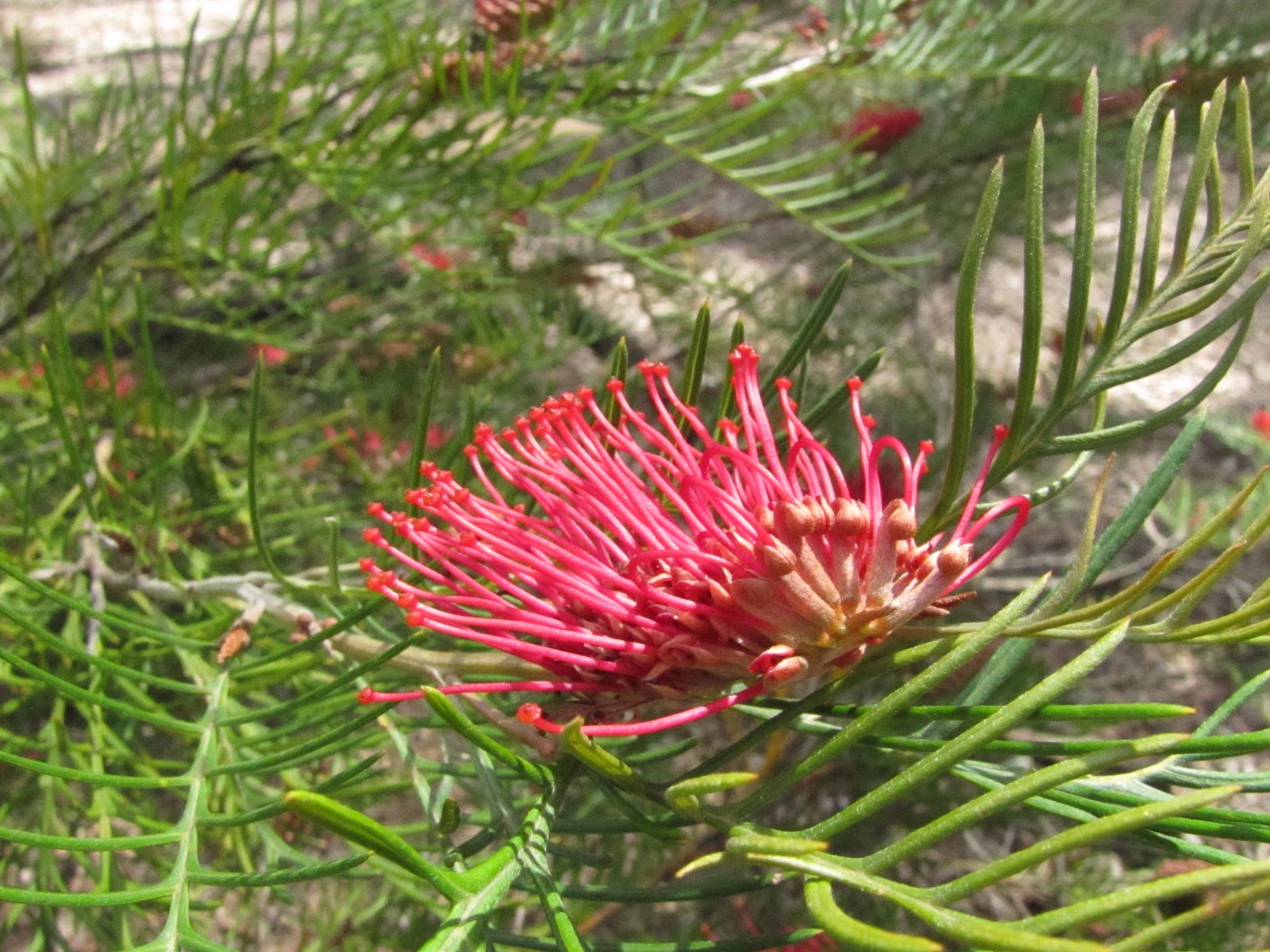
Today it was really warming up in the garden, beginning to feel like Australia should again - hot and sunny! I was determined to go and check on the little baby wattlebirds, despite some outrageously inappropriate footwear (stiletto boots) and a skirt.  So I tottered through the Banksia and around the Grevillea section, which is really beginning to come into bloom.  Some are only just starting, like the Grevillea beadleana, a very attractive 'toothbrush'-flowered variety endemic to a very small region in north eastern New South Wales, which I previously photographed in bloom back in March.  Another 'toothbrush' was in full flower and looking beautiful, Grevillea hookeriana - that species is much more widespread in the south-west of Western Australia.
There were lots of bees buzzing around some of the Grevillea, particularly this Grevillea juniperina hybrid where I managed to get a close up of a bee on the flower:
 Grevillea dimorpha, or the 'red spider flower', endemic to the Grampians in Victoria, was looking very good too - this flowers through Winter to Spring.  I wondered if it was called dimorpha as the flowers looked very spiky on some branches but rounded on others, but according to the Australian Plant Society Latrobe Valley Group 'dimorpha' is referring to the variable leaves.  Although called spider flower due to the shape of its flowers, I quite aptly found a tiny spider on one of the flowers (possibly a harmless garden orb spider?)

I also came across a new flower which is just as stunning as the Grevillea, Calothamnus quadrifidus or Common netbush (endemic to south-west Western Australia), Calothamnus literally means 'beautiful shrub' from Greek! 
Anyhow, enough about the flowers, what about those baby wattlebirds!  Well, I was amazed how much they had grown in just a week.  They have lost their scraggly necks, filling out with feathers and even beginning to show signs of the red lobes on their necks that gives them their name 'red' wattlebird. 

  I also spied what I think is another baby bird taking a bath.  I'm not sure what species he is, maybe some kind of Robin - he has those kind of eyes and beak?  There was an Eastern Yellow Robin nearby which may have been a parent, but really I don't know, anyone out there have any idea?! Anyhow, isn't he cute!