Showing posts with label Superb Fairy-wren. Show all posts

Sunday, 17 July 2011

On the right side of winter

The evenings are starting to get a little lighter again and now I feel we are on the right side of winter, spring is on its way.  There are some little signs in the garden, like the frisky male superb fairy wrens Malurus cyaneus darting everywhere and the thousands of star-like buds on the wattle (Acacia spp.) trees, just waiting to burst into bloom (and to give me hayfever!).

There are plenty of winter flowers out in the garden too, including many Banksia and this lovely flower, it is some sort of Grevillea (I couldn't find a label - it was just outside the main entrance to the gardens).

Tuesday, 12 October 2010

Bowerbirds and an empty nest

An empty nest!  The baby Red Wattlebirds I've been visiting for the past couple of weeks have now flown the nest.  I was amazed at how quickly they had grown up and felt a small sense of loss, my babies are out in the big wide world!  However, I didn't have to look very far to find them both, sitting in nearby bushes waiting for their parents to come and feed them.  One of them was trying some short flights from branch to branch, climbing higher into a tree, whilst the other was happy just to sit and wait in a bush.  I bet the active one was the bigger one in the nest that was always reaching higher for food!

If I'd had a little longer this lunchtime I might have got a shot of the parents feeding these little ones, I tried a couple of times but missed the moment, they are very quick!  I guess before another week is passed they might be fending for themselves. 

I ate lunch close to where I'd first seen the male Satin Bowerbird and after I'd finished I caught a glimpse of him chasing a female through the trees.  I followed them around for a bit, then saw him sitting in a tree - once again he was proving elusive...
...However, I managed to sneak up behind him as he made off towards the female and got a couple of good pictures.  One cheeky young Crimson Rosella sidled up next to him which was quite amusing (I know it is a young Rosella as there is still a lot of green on his wings - when he is an adult this changes to blue).  On my next adventure I will try and find the Satin Bowerbird's 'bower' - here is a link to a flickr gallery of what this might look like.  I like the description from a comment on there of what a bower is: 'they aren't nests. They are dance floors, discos, if you like, for picking up girls!'  So, more like a 'love nest'! The Satin Bowerbird has a fancy for all things blue to decorate his bower.  I've heard that in Canberra milk bottle tops used to be blue, but they had to change the colour as the Bowerbirds were stealing them!

 Just as I was leaving the gardens I couldn't resist trying to get a shot of a cute little breeding male Superb Fairy-wren who was hopping along the path - for once it was quite successful.   He has a few bird rings on his feet so seems he has been part of a survey at some point.  A number of studies of fairy-wrens have been conducted in these gardens by the ANU, some details of this work can be found on Professor Cockburn's webpage at the school of Botany and Zoology. 

Wednesday, 4 August 2010

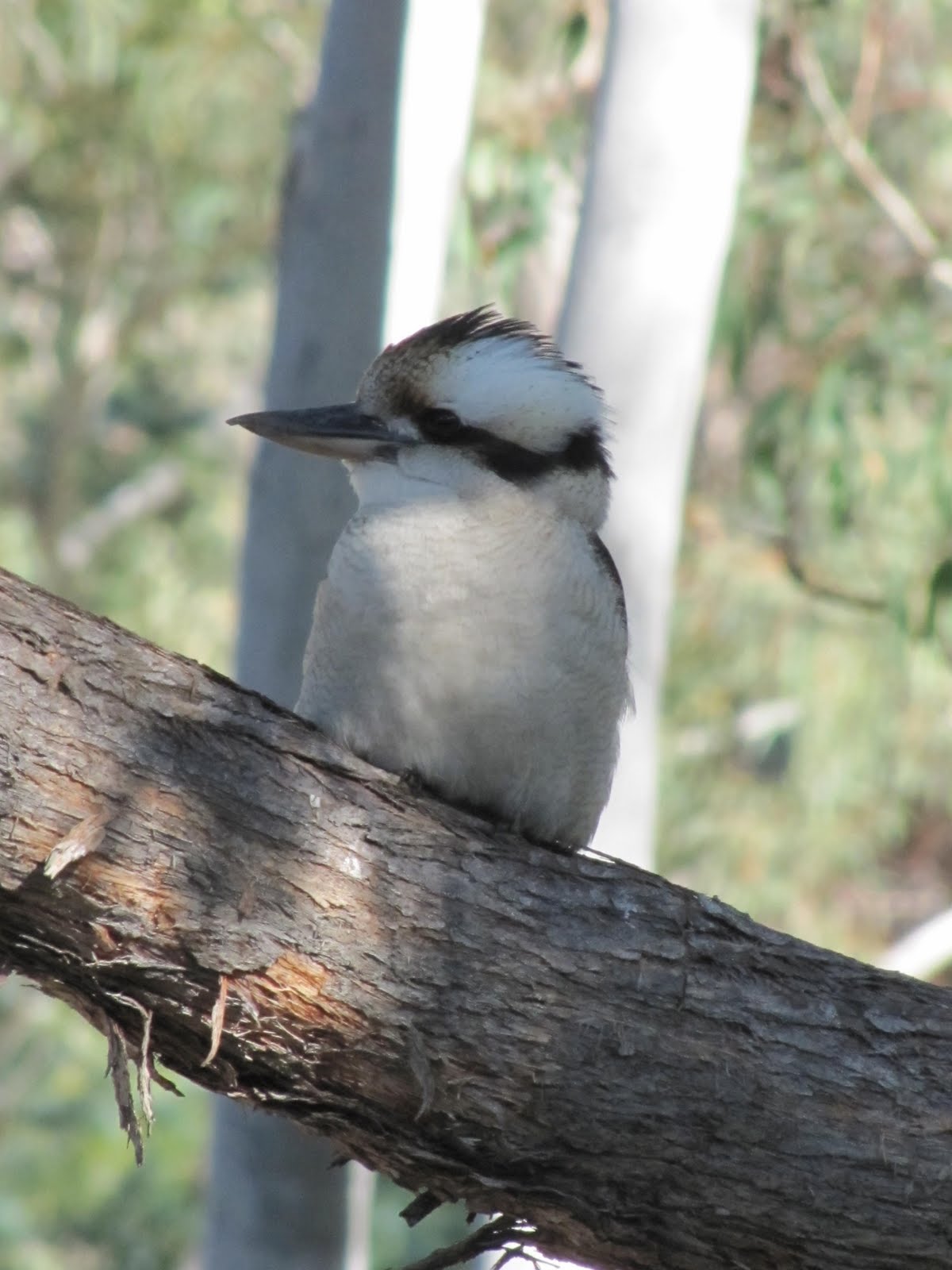
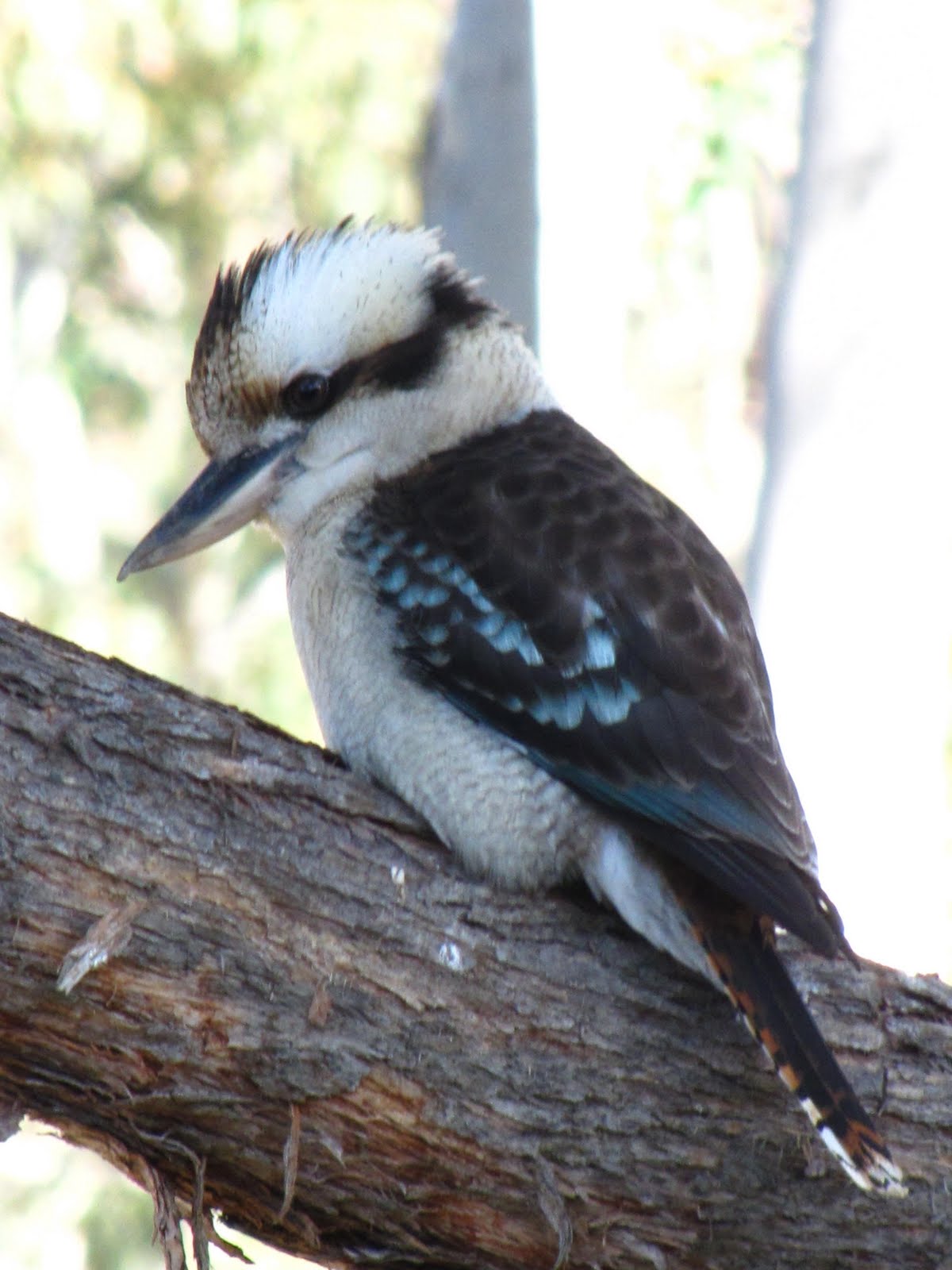
Baby Kookaburra!

Before I even made to the gardens today I took a look out of my office window and saw this lovely little Kookaburra Dacelo novaeguineae sitting in the trees close by.  I think he might be a baby, he is so fluffy!  Although not technically in the gardens I couldn't resist posting a few of the nice shots I took, it was great having him at eye-level (my office is on the 1st floor)!


There have been 3 Kookaburras flying about lately, they seemed to be getting quite territorial as they have been 'laughing' a lot!  In the last picture you can see some of the yellow of the Acacia that is starting to bloom in the background.  A quick trip to the gardens after that, I spied a little female Superb fairy-wren so tried (and failed) to get a good picture - the best effort is below as she was stretching up and looking towards me! 
A really stunning flower I hadn't seen before was in bloom and was attracting lots of New Holland Honeyeaters to feed on the nectar.  It is Calothamnus rupestris in the family Myrtaceae, or 'Mouse Ears' as it is commonly known! According to the link above, it is endemic to Western Australia in a relatively small region around Perth. 

Tuesday, 18 May 2010

We three kings

Three Kings were sitting high up in trees as I walked towards the gardens today - King Parrots Alisterus scapularis to be exact...

A closer look showed that they were three females - so more like Queens than Kings!
I went to eat lunch in my old favourite spot, but before I even got to the bench I was really excited to see that there was a male Galah Eolophus roseicapillus poking his little head out of the nest hole that has been vacant for a while!

He seemed to be on his own, unless his mate is inside there.  I will be keeping an eye out each lunchtime to see!  After sitting down on the bench I only managed a couple of bites of my sandwich before noticing some great photo opportunities for two birds that I'm always having trouble getting nice pictures of: an Eastern Spinebill Acanthorhynchus tenuirostris, doing a great pose in a Grevillea bush, and a wonderful male Superb Fairy Wren Malurus cyaneus in full breeding colours! 


Definitely some photos I'm really pleased with.  The little Fairy Wren kept hopping closer and closer, I wondered if he could smell my cheese sandwich.  The weather is getting quite nippy now, so I'm not seeing so many other people around in the gardens, certainly not eating lunch like me!  I've knitted myself some fingerless mittens that really help with eating lunch and taking photos in the cold weather.

I did bump into someone out and about which was a surprise - Robyn who follows this blog!  We hadn't met before but she guessed who I was by my pink bag.  Such a small world... I gave her sneak preview of some of my blog photos for today, I think she was a bit surprised by the next photo - some poo!  I had wondered if it was wombat poo, as Id heard a Facebook rumour about wombats in the gardens, however turns out it is just Kangaroo poo - though I didn't see any nearby.  Anyhow, it was interesting to know, so thanks Robyn!
I'm still wondering what this is on this Eucalyptus tree - Ive seen a lot of trees with this sort of growth on, anyone out there know? 

Sunday, 2 May 2010

Birds and Fairies

At long last, I've now got an Eastern Spinebill and New Holland Honeyeater picture I'm proud of!  In the last week I've had briefer lunches at work so not taken my camera to the gardens, however last Monday was a public holiday in Australia (Anzac day) and I took the opportunity to spend a little longer in the the gardens than usual and went there in the afternoon.  The result was better quality pictures of the more elusive birds in the gardens. The advice of my fellow blogger Mosura definitely helped: waiting patiently and taking lots of shots paid off. 

So, first the Eastern Spinebill Acanthorhynchus tenuirostris - not absolutely perfect as he is looking away from the camera, but the colours and focus are nice:

I then went to the rock garden where I sat for a while watching a New Holland Honeyeater Phylidonyris novaehollandiae flit around a small Banksia bush.  After a while he rested on top of a flower, so I got a few lovely pictures - he was quite fluffy, so may a young one, or just a bit chilly?!


I saw a Red Wattle Bird Anthochaera carunculata sitting on top of a bench.  These birds are very common in the gardens with a distinctive raucous call, however I got a couple of good shots Id like to include here.


I also got a picture of an Eastern Yellow Robin Eopsaltria australis, the first I'd seen in the gardens.  They have a very pretty bell-like call, which gave away his hiding place in a bush.
Finally, I also got some pictures of fairies! Well, the Superb Fairy-wren  Malurus cyaneus to be exact.  These are probably the hardest ones to get a shot of that I've seen - they are very small, fast movers and pretty shy!  The first is a female, the second and third pictures are a non-breeding male, these only have a blue tail whereas breeding males have a spectacular blue plumage.  Unlike the Galahs, fairy wrens are very promiscuous, apparently females may be courted by up to 13 males in half an hour!  They have a complex social structure, described here on this blog, where territories over-lap and a number of birds help bring up the young. 
I went to the gardens today, with the intention of doing the same and getting some better bird pictures to add to this collection.  I took a fantastic picture of a non-breeding male Fairy Wren with a lovely blue tail, however the memory card in my camera went loopy and wouldn't let me take any more pictures and appears to have wiped my Fairy Wren masterpiece, gutted!  So, that may be 'the one that got away'...