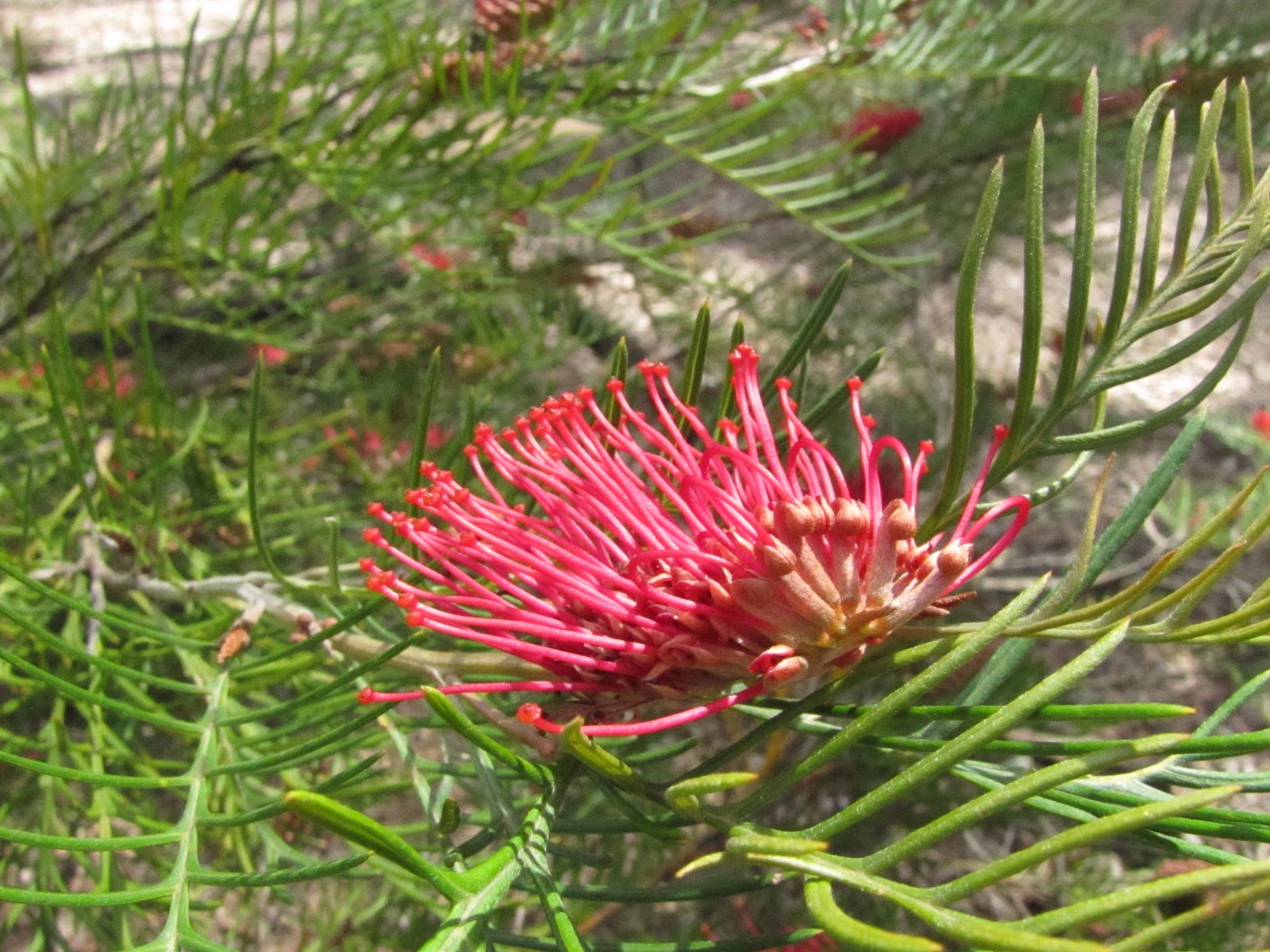
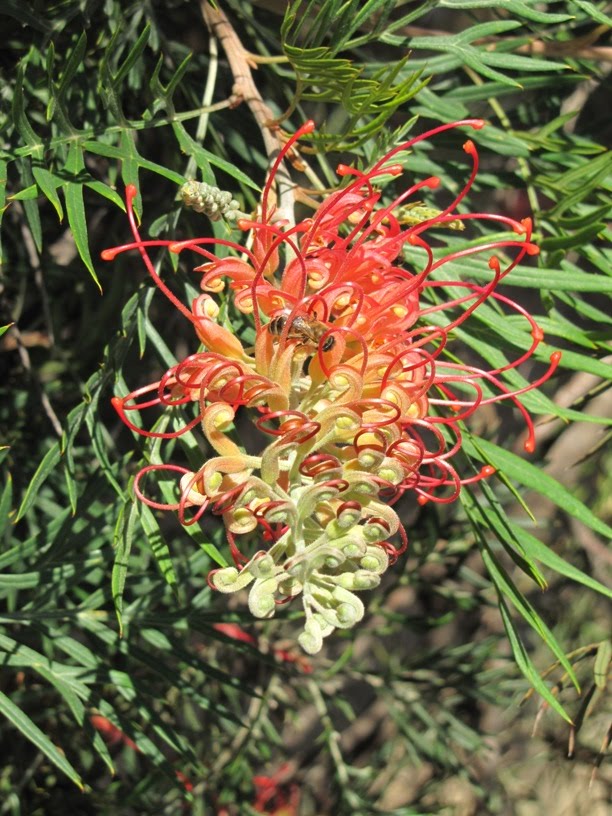
The evenings are starting to get a little lighter again and now I feel we are on the right side of winter, spring is on its way. There are some little signs in the garden, like the frisky male superb fairy wrens Malurus cyaneus darting everywhere and the thousands of star-like buds on the wattle (Acacia spp.) trees, just waiting to burst into bloom (and to give me hayfever!).
There are plenty of winter flowers out in the garden too, including many Banksia and this lovely flower, it is some sort of Grevillea (I couldn't find a label - it was just outside the main entrance to the gardens).
When I lived in Canberra, this blog was a diary of my lunchtime adventures in the Australian National Botanic Gardens. Seeing so many interesting things each lunchtime gave me the idea to practice my photography and share my experiences. In 2011 I moved to Brisbane and gained a position as a research scientist at CSIRO. This blog follows my latest adventures as I learn about the wonderful wildlife in this region.
Showing posts with label Grevillea. Show all posts
Sunday, 17 July 2011
Wednesday, 6 October 2010
The Grevilleas are back
Today it was really warming up in the garden, beginning to feel like Australia should again - hot and sunny! I was determined to go and check on the little baby wattlebirds, despite some outrageously inappropriate footwear (stiletto boots) and a skirt. So I tottered through the Banksia and around the Grevillea section, which is really beginning to come into bloom. Some are only just starting, like the Grevillea beadleana, a very attractive 'toothbrush'-flowered variety endemic to a very small region in north eastern New South Wales, which I previously photographed in bloom back in March. Another 'toothbrush' was in full flower and looking beautiful, Grevillea hookeriana - that species is much more widespread in the south-west of Western Australia.
There were lots of bees buzzing around some of the Grevillea, particularly this Grevillea juniperina hybrid where I managed to get a close up of a bee on the flower:
Grevillea dimorpha, or the 'red spider flower', endemic to the Grampians in Victoria, was looking very good too - this flowers through Winter to Spring. I wondered if it was called dimorpha as the flowers looked very spiky on some branches but rounded on others, but according to the Australian Plant Society Latrobe Valley Group 'dimorpha' is referring to the variable leaves. Although called spider flower due to the shape of its flowers, I quite aptly found a tiny spider on one of the flowers (possibly a harmless garden orb spider?)
I also came across a new flower which is just as stunning as the Grevillea, Calothamnus quadrifidus or Common netbush (endemic to south-west Western Australia), Calothamnus literally means 'beautiful shrub' from Greek!
Anyhow, enough about the flowers, what about those baby wattlebirds! Well, I was amazed how much they had grown in just a week. They have lost their scraggly necks, filling out with feathers and even beginning to show signs of the red lobes on their necks that gives them their name 'red' wattlebird.
I also spied what I think is another baby bird taking a bath. I'm not sure what species he is, maybe some kind of Robin - he has those kind of eyes and beak? There was an Eastern Yellow Robin nearby which may have been a parent, but really I don't know, anyone out there have any idea?! Anyhow, isn't he cute!
Grevillea dimorpha, or the 'red spider flower', endemic to the Grampians in Victoria, was looking very good too - this flowers through Winter to Spring. I wondered if it was called dimorpha as the flowers looked very spiky on some branches but rounded on others, but according to the Australian Plant Society Latrobe Valley Group 'dimorpha' is referring to the variable leaves. Although called spider flower due to the shape of its flowers, I quite aptly found a tiny spider on one of the flowers (possibly a harmless garden orb spider?)
I also came across a new flower which is just as stunning as the Grevillea, Calothamnus quadrifidus or Common netbush (endemic to south-west Western Australia), Calothamnus literally means 'beautiful shrub' from Greek!
Anyhow, enough about the flowers, what about those baby wattlebirds! Well, I was amazed how much they had grown in just a week. They have lost their scraggly necks, filling out with feathers and even beginning to show signs of the red lobes on their necks that gives them their name 'red' wattlebird.
I also spied what I think is another baby bird taking a bath. I'm not sure what species he is, maybe some kind of Robin - he has those kind of eyes and beak? There was an Eastern Yellow Robin nearby which may have been a parent, but really I don't know, anyone out there have any idea?! Anyhow, isn't he cute!
Sunday, 3 October 2010
More snaps of the baby wattlebirds
I couldn't resist going back to the gardens again on Friday to see if I could get some better pictures of the baby red wattlebirds. I had gone on Thursday without my camera and stood close by as one of the parents visited the nest and fed the babies, I was hoping I could catch that with my camera! I managed to zoom in and the babies were looking over the top of the nest this time so I could see their little beady eyes, however when mummy or daddy arrived there were just too many leaves in the way - you might be able to make out the yellow on the parent's chest in the last picture below?!
I will go back again next week and have another go, I guess they will be a little bigger then too! Lots of lovely flowers are all around the gardens, as well as the wattle of course. I took a picture of a very pretty yellow flower called Goodia lotifolia - that sounds a bit like some Latin I made up myself! This bush has a number of common names, the one on the label in the gardens was 'golden tip', which seemed very apt. Below that is Grevillea corrugata, a relatively rare Grevillea, endemic to a small region in South-western Australia near Bindoon. Philotheca 'poorinda', an unusual pretty pink cross between an Eriostemon and a Philotheca, in the background.
I also managed to get a nice shot of one of my favourite birds, a cute little Eastern Yellow Robin. I like them as they have a similar character to the Robin 'red-breast' we have in the UK: quite inquisitive and friendly, they like to sit and look at you for a while on a branch - also great for taking a photo too! However, the Eastern Yellow Robin is of the genus Eopsaltria, meaning 'dawn singer', unrelated to the European red robin, related instead to many tropical and Australian passerines including pardalotes, Fairy-wrens and honeyeaters.
Tuesday, 11 May 2010
Merry Merry King of the Bush
Today I thought I'd blog about some of the magnificent trees in the gardens, as they haven't really featured in my blog as yet and there are so many great trees! So, I started out in the obvious place to me, the Eucalypt Lawn. There are about 800 species of the genus Eucalyptus and this almost endemic flowering tree dominates the Australian flora in the non-desert regions. The Eucalypt Lawn has many different examples of the species laid out beautifully, creating a feeling of grandeur.
As I wandered across the lawn I noticed some interesting species common names - such as the large-fruited blackbutt Eucalyptus pyrocarpa and the Nunniong Gum Eucalyptus elaeophloia, 'discovered' in 1990, according to this CSIRO publication!
However, as I walked through the trees I heard the unmistakable laugh of the Kookaburra Dacelo novaeguineae. I was very excited, as I knew there are Kookaburras about as they often come to the trees outside my office, but I figured to take a picture of them there is 'cheating' as its not in the gardens, so I've been waiting to find them here. He was quiet for a bit, but then I spotted him sitting on a small tree, so I got a good shot as he surveyed the ground below:
Then he swooped down for his lunch! He was so quick and gobbled it up all at once that I only managed to get a picture when it was all gone:
So, I was somewhat distracted from my plan to blog about trees! I did notice one of the Eucalyptus trees had what looked like little branches growing out of it's trunk, I wonder if it was some Mistletoe recently attaching itself?
Unfortunately, it was already time to head back to the office, so the tree blog will have to wait for another day. However, on my way back I noticed a number of interesting flowers beginning to bloom and discovered they were of the Hakea genus. According to ANPSA these are often thought of as a poor relation to Grevillea, but I thought they deserve better than that, particularly the Hakea kincora which is an unusual and very pretty globular Hakea.
Another couple of Hakeas are pictured below, the delicate Hakea cycloptera according to Wikipedia commonly called the 'Elm-seed Hakea' and Hakea nodosa which apparently has a pungent smell, though I can't say I noticed!
Admittedly, the Grevilleas are stunning and two more species I noticed were in flower today, so I will finish with some pictures of two beauties from Western Australia. The first is Diels Grevillea Grevillea dielsiana - though according to that website it should flower in August-September, I suppose it behaves differently here in the East?! The other is the rare Collie Grevillea Grevillea ripicola, which is said to flower at this time of year or in late spring.
Labels:
Eucalyptus,
Grevillea,
Hakea,
Kookaburra,
Mistletoe
Saturday, 24 April 2010
Butterfly flutter by
I explored the rock garden on Friday, once again glorious Autumn weather. Having experienced all four seasons in Canberra now (I arrived here from the UK at the end of winter last August) I can say that this is definitely my favourite time of year. Beautifully cloudless sunny days, warm but not hot, gentle breezes, flowers blooming, plenty of birds and butterflies, glorious. My least favourite season had to be spring, in the UK I would love spring, but here there is so much pollen in the air at that time of year I got chronic hayfever and nosebleeds!! In any season though, getting out into the gardens is likely to be the highlight of my day, whatever the weather.
Walking up the path to the upper level of the rock garden I came across a stunning Grevillea at the side of the path, absolutely teeming with bees. I couldn't find a label, so unfortunately can't say which variety it is, but if you are in the rock garden you will easily find it as it is a very large bush.
At the top there was a fairly bare sunny area, with lots of strawflowers or everlasting daisies, Bracteantha bracteata where dozens of Australian painted ladies Vanessa kershawi were fluttering from plant to plant. My camera seems to do quite well taking pictures of butterflies and I love butterflies, so here are some of the many photos I took:
Another interesting thing I saw today was this seedpod on the Braidwood Waratah Telopea mongaensis. The waratah is another iconic Australian flower, blooming spectacularly in spring.
Walking up the path to the upper level of the rock garden I came across a stunning Grevillea at the side of the path, absolutely teeming with bees. I couldn't find a label, so unfortunately can't say which variety it is, but if you are in the rock garden you will easily find it as it is a very large bush.
At the top there was a fairly bare sunny area, with lots of strawflowers or everlasting daisies, Bracteantha bracteata where dozens of Australian painted ladies Vanessa kershawi were fluttering from plant to plant. My camera seems to do quite well taking pictures of butterflies and I love butterflies, so here are some of the many photos I took:
Another interesting thing I saw today was this seedpod on the Braidwood Waratah Telopea mongaensis. The waratah is another iconic Australian flower, blooming spectacularly in spring.
Thursday, 1 April 2010
A BBQ, Grevillea and a demonic looking bird
Today it was Thursday BBQ at CSIRO Entomology, but it was also the first chance Id had this week to take my camera along to the gardens - having had a couple of wet days at the start of the week I hadn't brought it along. The weather was glorious, so I was torn between being a social entomologist (a rare thing!) and going on my usual wanders. So, I decided to do both! First, beer and BBQ...
...second, a quick sprint around with my camera to see what I could see! There were plenty of Crimson Rosellas Platycercus elegans about, quite a bit of argy bargy seemed to be going on, though it isn't breeding season so I'm not sure why!
I stayed quite close to the CSIRO gate as I was short on time, but good fortune led me to wander amongst the Grevilleas, many of which are beginning to flower beautifully (apparently winter to early spring would be the peak flowering period). The Grevilleas are intricate formations of delicate clustered flowers growing on shrubs, very popular in Australian gardens. According to the excellent Botanical garden facts on the genus, "Grevillea is named after Charles Francis Greville who was one of the founders of the Royal Horticultural Society in 1804. There are over 300 species in the genus, most of which are endemic to Australia but a few species occur in Papua New Guinea and islands to Australia's north".

Having now read the ANBG weekly update on what is in flower, I've deduced that the yellow flower is probably Acacia subulata.
As I was leaving, a little flock of Choughs Corcorax melanorhamphos were hanging around the gate - they are lively little fellows, although boldly coming right up to glare at me with their red demonic eyes it was hard to get a good picture. Although sinister looking they are really quite inquisitive friendly chaps:
...second, a quick sprint around with my camera to see what I could see! There were plenty of Crimson Rosellas Platycercus elegans about, quite a bit of argy bargy seemed to be going on, though it isn't breeding season so I'm not sure why!
I stayed quite close to the CSIRO gate as I was short on time, but good fortune led me to wander amongst the Grevilleas, many of which are beginning to flower beautifully (apparently winter to early spring would be the peak flowering period). The Grevilleas are intricate formations of delicate clustered flowers growing on shrubs, very popular in Australian gardens. According to the excellent Botanical garden facts on the genus, "Grevillea is named after Charles Francis Greville who was one of the founders of the Royal Horticultural Society in 1804. There are over 300 species in the genus, most of which are endemic to Australia but a few species occur in Papua New Guinea and islands to Australia's north".
Here is Grevillea vestita a very delicate white variety and an interesting hybrid Grevillea called Sid Reynolds:

I also spotted a couple of lovely flowers without labels, the yellow ones in the Grevillea section and the other in the Teleopea section - neither of which belong there I don't think?!
Having now read the ANBG weekly update on what is in flower, I've deduced that the yellow flower is probably Acacia subulata.
As I was leaving, a little flock of Choughs Corcorax melanorhamphos were hanging around the gate - they are lively little fellows, although boldly coming right up to glare at me with their red demonic eyes it was hard to get a good picture. Although sinister looking they are really quite inquisitive friendly chaps:
but they do look demonic!
Tuesday, 23 March 2010
A Mighty Dragon
At the weekend I spent a very peaceful Sunday afternoon in a quiet corner of the garden with my knitting, while Edd (my partner) was at work at Tidbinbilla. I found a lovely bench surrounded by wattle bushes and saw plenty of birds, including a Gang-gang Cockatoo Callocephalon fimbriatum. A family of cheeky Kangaroos were nearby, nibbling on the flora - lucky for them no gardeners were near! But, unfortunately I ignored the golden rule on Sunday - no camera! So, I returned to this great spot in the garden today (high up above the rock garden, looking across the city to mount Ainslie) to see what would visit...
It wasn't long before a small gang of Eastern Spinebill Acanthorhynchus tenuirostris appeared. As they were flitting from branch to branch it was tricky to get a picture, but this one came out ok:
These birds feed on nectar, of which there seems to be an abundant supply in the gardens at the moment. A constant buzzing can be heard as bees gorge themselves on Bottlebrush Callistemon and Grevillea beadleana, both pictured below (with bees!). The Grevillea beadleana is a rare and endangered plant from Northern NSW, thought to be extinct until rediscovered in the 1970s!
My favourite encounter this lunchtime had to be this large Water Dragon. I love taking pictures of reptiles, they are so beautiful with their amazing patterned skin that nearly always takes a great photo, and best of all, they usually like to stay still and pose for me!
It wasn't long before a small gang of Eastern Spinebill Acanthorhynchus tenuirostris appeared. As they were flitting from branch to branch it was tricky to get a picture, but this one came out ok:
These birds feed on nectar, of which there seems to be an abundant supply in the gardens at the moment. A constant buzzing can be heard as bees gorge themselves on Bottlebrush Callistemon and Grevillea beadleana, both pictured below (with bees!). The Grevillea beadleana is a rare and endangered plant from Northern NSW, thought to be extinct until rediscovered in the 1970s!
My favourite encounter this lunchtime had to be this large Water Dragon. I love taking pictures of reptiles, they are so beautiful with their amazing patterned skin that nearly always takes a great photo, and best of all, they usually like to stay still and pose for me!
Subscribe to:
Posts (Atom)