Showing posts with label Wattle Bird. Show all posts

Tuesday, 12 October 2010

Bowerbirds and an empty nest

An empty nest!  The baby Red Wattlebirds I've been visiting for the past couple of weeks have now flown the nest.  I was amazed at how quickly they had grown up and felt a small sense of loss, my babies are out in the big wide world!  However, I didn't have to look very far to find them both, sitting in nearby bushes waiting for their parents to come and feed them.  One of them was trying some short flights from branch to branch, climbing higher into a tree, whilst the other was happy just to sit and wait in a bush.  I bet the active one was the bigger one in the nest that was always reaching higher for food!

If I'd had a little longer this lunchtime I might have got a shot of the parents feeding these little ones, I tried a couple of times but missed the moment, they are very quick!  I guess before another week is passed they might be fending for themselves. 

I ate lunch close to where I'd first seen the male Satin Bowerbird and after I'd finished I caught a glimpse of him chasing a female through the trees.  I followed them around for a bit, then saw him sitting in a tree - once again he was proving elusive...
...However, I managed to sneak up behind him as he made off towards the female and got a couple of good pictures.  One cheeky young Crimson Rosella sidled up next to him which was quite amusing (I know it is a young Rosella as there is still a lot of green on his wings - when he is an adult this changes to blue).  On my next adventure I will try and find the Satin Bowerbird's 'bower' - here is a link to a flickr gallery of what this might look like.  I like the description from a comment on there of what a bower is: 'they aren't nests. They are dance floors, discos, if you like, for picking up girls!'  So, more like a 'love nest'! The Satin Bowerbird has a fancy for all things blue to decorate his bower.  I've heard that in Canberra milk bottle tops used to be blue, but they had to change the colour as the Bowerbirds were stealing them!

 Just as I was leaving the gardens I couldn't resist trying to get a shot of a cute little breeding male Superb Fairy-wren who was hopping along the path - for once it was quite successful.   He has a few bird rings on his feet so seems he has been part of a survey at some point.  A number of studies of fairy-wrens have been conducted in these gardens by the ANU, some details of this work can be found on Professor Cockburn's webpage at the school of Botany and Zoology. 

Wednesday, 6 October 2010

The Grevilleas are back

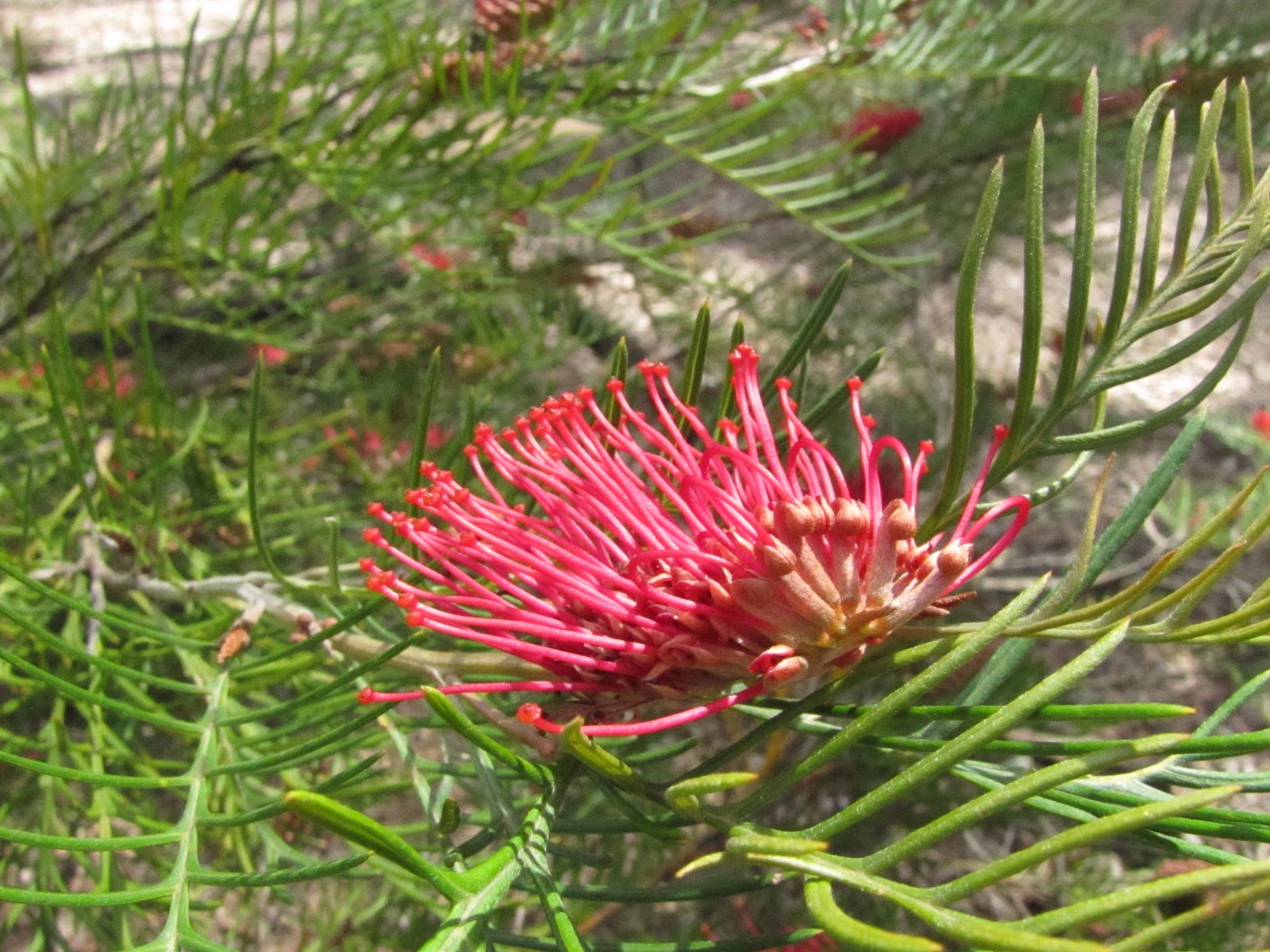
Today it was really warming up in the garden, beginning to feel like Australia should again - hot and sunny! I was determined to go and check on the little baby wattlebirds, despite some outrageously inappropriate footwear (stiletto boots) and a skirt.  So I tottered through the Banksia and around the Grevillea section, which is really beginning to come into bloom.  Some are only just starting, like the Grevillea beadleana, a very attractive 'toothbrush'-flowered variety endemic to a very small region in north eastern New South Wales, which I previously photographed in bloom back in March.  Another 'toothbrush' was in full flower and looking beautiful, Grevillea hookeriana - that species is much more widespread in the south-west of Western Australia.
There were lots of bees buzzing around some of the Grevillea, particularly this Grevillea juniperina hybrid where I managed to get a close up of a bee on the flower:
 Grevillea dimorpha, or the 'red spider flower', endemic to the Grampians in Victoria, was looking very good too - this flowers through Winter to Spring.  I wondered if it was called dimorpha as the flowers looked very spiky on some branches but rounded on others, but according to the Australian Plant Society Latrobe Valley Group 'dimorpha' is referring to the variable leaves.  Although called spider flower due to the shape of its flowers, I quite aptly found a tiny spider on one of the flowers (possibly a harmless garden orb spider?)

I also came across a new flower which is just as stunning as the Grevillea, Calothamnus quadrifidus or Common netbush (endemic to south-west Western Australia), Calothamnus literally means 'beautiful shrub' from Greek! 
Anyhow, enough about the flowers, what about those baby wattlebirds!  Well, I was amazed how much they had grown in just a week.  They have lost their scraggly necks, filling out with feathers and even beginning to show signs of the red lobes on their necks that gives them their name 'red' wattlebird. 

  I also spied what I think is another baby bird taking a bath.  I'm not sure what species he is, maybe some kind of Robin - he has those kind of eyes and beak?  There was an Eastern Yellow Robin nearby which may have been a parent, but really I don't know, anyone out there have any idea?! Anyhow, isn't he cute! 

Sunday, 3 October 2010

More snaps of the baby wattlebirds

I couldn't resist going back to the gardens again on Friday to see if I could get some better pictures of the baby red wattlebirds.  I had gone on Thursday without my camera and stood close by as one of the parents visited the nest and fed the babies, I was hoping I could catch that with my camera!  I managed to zoom in and the babies were looking over the top of the nest this time so I could see their little beady eyes, however when mummy or daddy arrived there were just too many leaves in the way - you might be able to make out the yellow on the parent's chest in the last picture below?!
 I will go back again next week and have another go, I guess they will be a little bigger then too!  Lots of lovely flowers are all around the gardens, as well as the wattle of course.  I took a picture of a very pretty yellow flower called Goodia lotifolia - that sounds a bit like some Latin I made up myself!  This bush has a number of common names, the one on the label in the gardens was 'golden tip', which seemed very apt.  Below that is Grevillea corrugata, a relatively rare Grevillea, endemic to a small region in South-western Australia near Bindoon.  Philotheca 'poorinda', an unusual pretty pink cross between an Eriostemon and a Philotheca, in the background. 
 I also managed to get a nice shot of one of my favourite birds, a cute little Eastern Yellow Robin.  I like them as they have a similar character to the Robin 'red-breast' we have in the UK: quite inquisitive and friendly, they like to sit and look at you for a while on a branch - also great for taking a photo too! However, the Eastern Yellow Robin is of the genus Eopsaltria, meaning 'dawn singer', unrelated to the European red robin, related instead to many tropical and Australian passerines including pardalotes, Fairy-wrens and honeyeaters. 

Wednesday, 29 September 2010

What a load of Wattle!

I have been away on various trips lately and so it has taken a while since my last blog for me to get around to photographing the glorious yellow blooms of the Wattle.  They are simply bursting like rays of bright sunshine across the gardens, Spring is here!  The Golden Wattle, Acacia pycnantha is Australia's floral emblem - you can read about its significance on the ANBG website here.  I really don't remember the Wattle looking so amazing last year, as a pom I see it as Australia's answer to the Daffodil. 


So beautiful.  As I was wandering around taking Wattle pictures I heard a strange rasping noise I'd never heard before coming from a Banksia bush.  I looked hard and worked out where the noise was coming from - a Red Wattlebird's nest!  One of the parents was nearby (not sure if it was Mum or Dad - both parents feed the young).  I didn't want to disturb the nest or frighten the chicks so I couldn't get my camera very close and used the zoom, but the nest was quite well concealed in the Banksia, despite being at eye-level!  Here are a couple of shots of the chicks (you will have to look hard amongst the leaves in the first photo) and parent on the lookout up in a tree. 


Nearby a kangaroo was grazing, he has a very friendly sort of face (not sure if it is a he but it seemed like a 'he' - no joey in sight anyhow!). 


As I was leaving the gardens I came across a new bird I hadn't seen before, always very exciting particularly in these gardens that I visit so often.  It was a Satin Bowerbird Ptilonorhynchus violaceus, and a fully mature male at that - young males may begin to acquire their adult plumage in their fifth year and are not fully 'attired' until they are seven.  His colour was gorgeous, the most beautiful deep shiny dark blue all over.  He was a bit elusive however, I spent a while chasing him round some bushes trying to get a clear shot but he wasn't co-operating and I had to get back to the office... so this is the best I managed!   Hopefully I will see him again and be able to get a better picture next time. 

Sunday, 2 May 2010

Birds and Fairies

At long last, I've now got an Eastern Spinebill and New Holland Honeyeater picture I'm proud of!  In the last week I've had briefer lunches at work so not taken my camera to the gardens, however last Monday was a public holiday in Australia (Anzac day) and I took the opportunity to spend a little longer in the the gardens than usual and went there in the afternoon.  The result was better quality pictures of the more elusive birds in the gardens. The advice of my fellow blogger Mosura definitely helped: waiting patiently and taking lots of shots paid off. 

So, first the Eastern Spinebill Acanthorhynchus tenuirostris - not absolutely perfect as he is looking away from the camera, but the colours and focus are nice:

I then went to the rock garden where I sat for a while watching a New Holland Honeyeater Phylidonyris novaehollandiae flit around a small Banksia bush.  After a while he rested on top of a flower, so I got a few lovely pictures - he was quite fluffy, so may a young one, or just a bit chilly?!


I saw a Red Wattle Bird Anthochaera carunculata sitting on top of a bench.  These birds are very common in the gardens with a distinctive raucous call, however I got a couple of good shots Id like to include here.


I also got a picture of an Eastern Yellow Robin Eopsaltria australis, the first I'd seen in the gardens.  They have a very pretty bell-like call, which gave away his hiding place in a bush.
Finally, I also got some pictures of fairies! Well, the Superb Fairy-wren  Malurus cyaneus to be exact.  These are probably the hardest ones to get a shot of that I've seen - they are very small, fast movers and pretty shy!  The first is a female, the second and third pictures are a non-breeding male, these only have a blue tail whereas breeding males have a spectacular blue plumage.  Unlike the Galahs, fairy wrens are very promiscuous, apparently females may be courted by up to 13 males in half an hour!  They have a complex social structure, described here on this blog, where territories over-lap and a number of birds help bring up the young. 
I went to the gardens today, with the intention of doing the same and getting some better bird pictures to add to this collection.  I took a fantastic picture of a non-breeding male Fairy Wren with a lovely blue tail, however the memory card in my camera went loopy and wouldn't let me take any more pictures and appears to have wiped my Fairy Wren masterpiece, gutted!  So, that may be 'the one that got away'...

Thursday, 18 March 2010

First adventure

So, Ive managed to remember the golden rule of photography - bring a camera.  Fortunately, I also remembered rule number 2 - bring spare batteries - as my batteries died after I took my first photo of the garden sign! 

I headed to my favourite bench for lunch - its the furthest one Ive found from a main path, in a sunny Eucalyptus glade...
The garden is full of birds and butterflies today as it is beautifully warm and sunny.  I could hear buzzing and bird calls all around me as I ate my sandwiches.  A Red Wattlebird - Anthochaera carunculata sat in a Eucalyptus nearby.  According to the botanical garden bird guide, The red wattlebird is "one of the most common (and raucous) birds in the Gardens. They are generally seen feeding on the nectar of the many banksias, waratahs and grevilleas. Red Wattlebirds (named because of the red lobes of skin, called 'wattles', at the side of the neck) also feed on insects and fruit. They occur naturally in native forests and woodlands of southern Australia and are common in parks and gardens".
 After lunch I just did a little circuit of the glade.  I took a picture of the very attractive local native plant Lambertia Formosa or the wonderfully named 'Mountain devil', only found on the coast and adjacent mountains of New South Wales.  It usually flowers in winter or spring, but evidently some flowers can be present all year.  The black dots are ants crawling over the lovely flower...
I also spied some nest boxes, or perhaps bat boxes, I'm not sure who they are for, I will try to find out...

On my way back to my office I spied this tiny little fellow, I couldn't get a good picture of him (I should learn how to manual focus...):
I've not seen a little bird like this before so I looked him up, he appears to be a Red Browed Finch Neochmia temporalis.

So, that was my first adventure for my blog, hope you liked it!