Showing posts with label Eucalyptus. Show all posts

Saturday, 12 May 2012

A lone Koala on Mount Gravatt

Well, we are getting quite proud of our Koala spotting abilities, we have a 100% record for Koala spotting on Mt Gravatt since we first spotted the Koala family back in January! We went a little walk below the Federation lookout again where we have spotted them before, and came across this lone Koala in a tall tree near a bridge, pictured below.


The Koala was very high up in the large tree pictured above next to the path, so it was hard to get a clear picture.  I don't know which member of the Koala family it was, I'm pretty sure not the mother (as her ears were not very furry and she was more brown in colour, as well as her head seemed smaller - an indiation that this Koala is a male) so maybe it was the Dad, or it could be the Joey all grown up?! Anyhow, he looked very healthy and well fed.
When I tell people I've spotted a Koala they always ask 'what tree was it in'.  Unfortunately, 'Eucalyptus' is not a satisfactory answer - Koalas are rather fussy! Well, I have to confess, I've not been in Australia long enough yet to really appreciate the differences between Eucalypts, however I thought I'd take a picture of the tree trunk and some leaves (behind the Koala) below to make some attempt to identify the tree.  Any suggestions?!


With some internet research added to my limited knowledge, I've come up with:
- some kind of Stringybark Eucalyptus
- I looked at this very handy guide to the ID of Eucalypts in the Brisbane region (I will have to print it) and narrowed it down to being most likely one of the first three in the list as they are known to be Koala food:  Swamp Mahogany Eucalyptus robusta, Red mahogany/stringybark Eucalyptus resinifera or Tallowwood Eucalyptus microcorys.  
I'm pretty sure this is a different species to the Eucalypts we have seen the Koalas on previously as the tree bark was distinctly different.  I came across more detail on local Koala food trees on the DERM website.
In my internet search I was also interested to read on the Griffith University website (whose campus is on part of the mountain) that the Mt Gravatt reserve has some rather rare Eucalypt species: Eucalyptus Baileyana and Eucalyptus Planchoniana - now there is a challenge to try and find and identify one!  They are also Stringybark, so would look quite similar to this one.    

Friday, 11 March 2011

A soldier mating frenzy

Its been far too long since I last posted.  In that time all the bark has been falling off the Eucalyptus trees as we are nearing the end of summer, so that they are now all quite naked. 
Apparently the process of bark shedding is accelerated after rain, as the bark softens and peels more easily.  Today was a wet day in the gardens - I love wet days.  The gardens are always quiet on those days (without people), but very much alive, I feel certain the birds all come out to play after the rain.  Today there were lots of little birds flitting around near the garden gate and I managed to get a picture of two fast movers I've not managed to capture before, a pretty little Spotted Pardalote Pardalotus punctatus and a Grey Fantail Rhipidura fuliginosa, which has a very acrobatic flight.   
As I was taking a photo of some striking Eucalyptus on the Eucalypt Lawn, I noticed that where the bark was peeling from the tree lots of beetles had gathered.  Looking closely I saw they were all coupled up, it was a beetle orgy!  These are Green Soldier Beetles Chauliognathus sp., also known as Plague Solider Beetles - they are known to gather together in large numbers for the purpose of breeding.  Some amusing stories I found on the web - one report that in February 2009 a school in the Blue Mountains closed its library when so many beetles were found over the walls.  The Australian Museum writes that although the beetles may gather in huge numbers on plants they are far more interested in mating than eating, so don't pose much threat as a pest!
 
So, where the old bark peels off the Eucalyptus trees the beetles gather to create new life, the circle of life goes on. 

Sunday, 20 June 2010

Trees and a dinosaur

Its been a little while since my last post so I'm playing a bit of catch-up.  I had a friend visit from the UK so was occupied showing him the mighty sights of Canberra!  Of course, the Botanic Gardens were first on the list and I took plenty of pictures, only I've not had time to write a blog until now (as then we went off for a few days to Byron Bay - great place!)

So, with a visitor to impress I decided to head for probably the most exciting tree in the garden - the Wollemi Pine Wollemia nobilis, the 'dinosaur' tree.  I've just finished reading the book about "the incredible discovery of a living fossil from the age of the dinosaurs" - the Wollemi Pine by James Woodford, which is a great read (I also loved his book 'The Secret Life of Wombats'), so now I know a bit about how amazing this tree is.  Not only is it incredible that the Wollemi pine has survived in such improbable isolation across millennia, only to be discovered in the mid-90s (and only recently available commercially), but its identical genes have baffled scientists, it has unique bark and leaves, even a fungus found on the leaves of some of the wild trees has been found to produce an anti-cancer agent - amazing. To this day, the location of the hidden valley in the Wollemi wilderness near Sydney where the relic trees were found is a secret.
As I proudly showed the tree to my buddy from the UK he smiled and said he had seen one before - in Kew gardens in London!  However, there it is kept in a cage for protection but here in Canberra this amazing tree is just standing quietly beside a side path through the connifer section. 

There are a lot of other fascinating trees in the gardens too, of course.  There is even an aboriginal trail that tells you the aboriginal uses for plants and trees, from which I learnt about the how the aborigines used the hard wood of the Cassaurina or she-oak to make boomerangs, one she-oak boomerang has been found that is 10,000 years old in Wyrie Swamp, South Australia!  Young shoots can be chewed to quench thirst. 

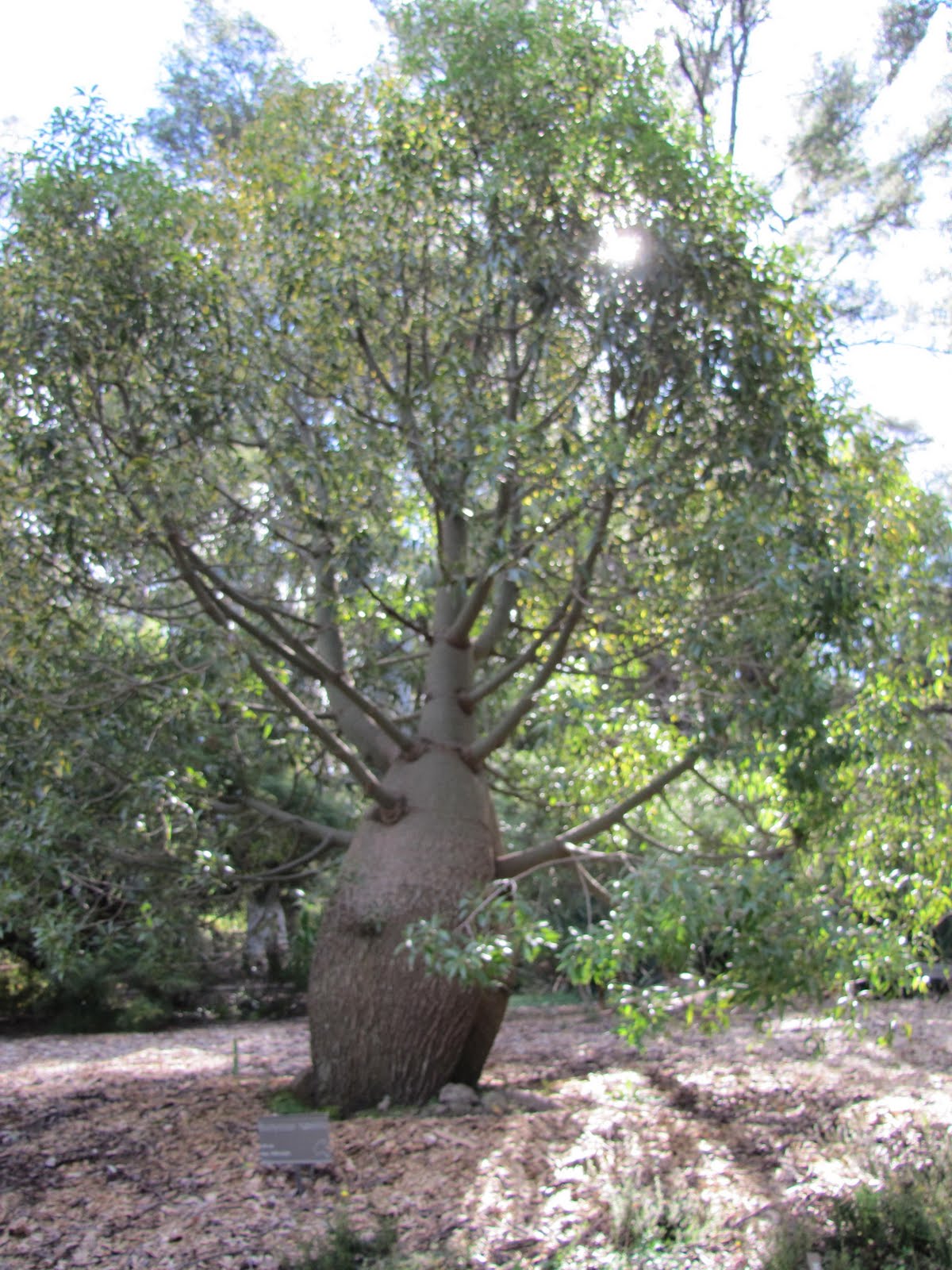
The Bottle tree Brachychiton rupestris is a fascinating tree which hails from Queensland, not only for its very funky shape but also because the wood contains a nutritious jelly which can be obtained to drink by making a hole in the trunk (which can be up to 2m in diameter!). 

There are also hundreds of Eucalyptus trees in the garden, in particular the Brittle gum Eucalyptus mannifera which appears all around the gardens. 


The one above is interesting as a large branch has been chopped off so the inside of the tree can be seen.  Brittle gums are so-called as they may drop branches without warning (so perhaps this one was removed before it dropped), makes me a little more nervous wandering round the gardens now I know that!  This particular tree is also interesting as it is known as the 'Pryor tree', in tribute to Lindsay Pryor who was instrumental in getting funding for the establishment of the gardens.  Below is a photo of the sign that tells more about this tree, including a photo which was taken when the tree had all its branches!

Tuesday, 11 May 2010

Merry Merry King of the Bush

Today I thought I'd blog about some of the magnificent trees in the gardens, as they haven't really featured in my blog as yet and there are so many great trees!  So, I started out in the obvious place to me, the Eucalypt Lawn.  There are about 800 species of the genus Eucalyptus and this almost endemic flowering tree dominates the Australian flora in the non-desert regions.  The Eucalypt Lawn has many different examples of the species laid out beautifully, creating a feeling of grandeur. 


As I wandered across the lawn I noticed some interesting species common names - such as the large-fruited blackbutt Eucalyptus pyrocarpa and the Nunniong Gum Eucalyptus elaeophloia, 'discovered' in 1990, according to this CSIRO publication!  

However, as I walked through the trees I heard the unmistakable laugh of the Kookaburra Dacelo novaeguineae.  I was very excited, as I knew there are Kookaburras about as they often come to the trees outside my office, but I figured to take a picture of them there is 'cheating' as its not in the gardens, so I've been waiting to find them here.  He was quiet for a bit, but then I spotted him sitting on a small tree, so I got a good shot as he surveyed the ground below:
Then he swooped down for his lunch!  He was so quick and gobbled it up all at once that I only managed to get a picture when it was all gone:
So, I was somewhat distracted from my plan to blog about trees!  I did notice one of the Eucalyptus trees had what looked like little branches growing out of it's trunk, I wonder if it was some Mistletoe recently attaching itself?
Unfortunately, it was already time to head back to the office, so the tree blog will have to wait for another day.  However, on my way back I noticed a number of interesting flowers beginning to bloom and discovered they were of the Hakea genus.  According to ANPSA these are often thought of as a poor relation to Grevillea, but I thought they deserve better than that, particularly the Hakea kincora which is an unusual and very pretty globular Hakea. 
Another couple of Hakeas are pictured below, the delicate Hakea cycloptera according to Wikipedia commonly called the 'Elm-seed Hakea' and Hakea nodosa which apparently has a pungent smell, though I can't say I noticed!

Admittedly, the Grevilleas are stunning and two more species I noticed were in flower today, so I will finish with some pictures of two beauties from Western Australia.  The first is Diels Grevillea Grevillea dielsiana - though according to that website it should flower in August-September, I suppose it behaves differently here in the East?!  The other is the rare Collie Grevillea Grevillea ripicola, which is said to flower at this time of year or in late spring.