I feel these 'grassroots' campaigns are beginning to make some ripples in the perception that Australia has boundless resources. But is it too little too late? Please wake up Australia to what is happening in your backyard... !

Friday, 18 May 2012
The march of coal and CSG
Since moving to Queensland I have been both moved at the beauty around me but also by the scale of the environmental threats which seem to be most acute in this part of Australia. Not only is there a threat to now 'endangered' species like the Koala from urbanisation,which I see regularly on my walks on the 'island' of Mt Gravatt, but there is a large and dark shadow looming over rural Australia extending its reach to the Great Barrier Reef: Open cut Coal and Coal Seam Gas (CSG) mining. This video just released by GetUp! explains some of the threats from mining in a simple and accessible way:
Having now seen the Bimblebox documentary at a UQ screening I feel so motivated to try and take action and I couldn't resist to make a blog post about this. So, what to do?! Well, besides GetUp!, Lock the Gate campaign is raising public awareness, particularly in rural areas, of the potential impact this will have (particularly CSG) on physical, social, environmental and economic wellbeing. The strange law in Australia that one can own what is on the land's surface but the state retains rights to what is below (and so can transfer those rights literally from under the farmer to mining) is something that is making it easier for mining companies to put a lot of pressure on farmland and nature reserves. I feel that just because it is there, does it mean we have to mine it? - surely there is a better way! Beyond Zero Emissions is another worthy campaign that aims to provide a solution and blueprint to guide Australia to reduce emissions 'beyond zero' within a timespan of 10 years. I would love to see some of the big bucks from mining, defence etc. go into the shrinking budgets of our universities and scientific institutions to really crack the renewable energy problem and address other issues of sustainability like global food security.
I feel these 'grassroots' campaigns are beginning to make some ripples in the perception that Australia has boundless resources. But is it too little too late? Please wake up Australia to what is happening in your backyard... !
I feel these 'grassroots' campaigns are beginning to make some ripples in the perception that Australia has boundless resources. But is it too little too late? Please wake up Australia to what is happening in your backyard... !


Saturday, 12 May 2012
A lone Koala on Mount Gravatt
Well, we are getting quite proud of our Koala spotting abilities, we have a 100% record for Koala spotting on Mt Gravatt since we first spotted the Koala family back in January! We went a little walk below the Federation lookout again where we have spotted them before, and came across this lone Koala in a tall tree near a bridge, pictured below.


 The Koala was very high up in the large tree pictured above next to the path, so it was hard to get a clear picture. I don't know which member of the Koala family it was, I'm pretty sure not the mother (as her ears were not very furry and she was more brown in colour, as well as her head seemed smaller - an indiation that this Koala is a male) so maybe it was the Dad, or it could be the Joey all grown up?! Anyhow, he looked very healthy and well fed.
When I tell people I've spotted a Koala they always ask 'what tree was it in'. Unfortunately, 'Eucalyptus' is not a satisfactory answer - Koalas are rather fussy! Well, I have to confess, I've not been in Australia long enough yet to really appreciate the differences between Eucalypts, however I thought I'd take a picture of the tree trunk and some leaves (behind the Koala) below to make some attempt to identify the tree. Any suggestions?!


With some internet research added to my limited knowledge, I've come up with:
- some kind of Stringybark Eucalyptus
- I looked at this very handy guide to the ID of Eucalypts in the Brisbane region (I will have to print it) and narrowed it down to being most likely one of the first three in the list as they are known to be Koala food: Swamp Mahogany Eucalyptus robusta, Red mahogany/stringybark Eucalyptus resinifera or Tallowwood Eucalyptus microcorys.
I'm pretty sure this is a different species to the Eucalypts we have seen the Koalas on previously as the tree bark was distinctly different. I came across more detail on local Koala food trees on the DERM website.
In my internet search I was also interested to read on the Griffith University website (whose campus is on part of the mountain) that the Mt Gravatt reserve has some rather rare Eucalypt species: Eucalyptus Baileyana and Eucalyptus Planchoniana - now there is a challenge to try and find and identify one! They are also Stringybark, so would look quite similar to this one.
Monday, 7 May 2012
Glider Forest
Wildlife Queensland and their Glider Network organised a morning for the public to help with nestbox monitoring in a patch of bushland called Glider Forest, in Larapinta (south Brisbane). This included hunting for some nestboxes that were put up years ago but never monitored! Gliders, like possums, are nocturnal and sleep during the day, so the nestboxes provide an important substitute for tree hollows in areas that have suffered from tree clearing.

We started out by looking for some nestboxes that had not been located with the GPS. The group leader knew roughly where they were, making the task a bit easier, and a couple of the youngsters with us had keen eyes so we found them without too much trouble. Then the fun began - we used a special camera to take a look inside the boxes! Here is a video from Wildlife Queensland that explains how the remote camera works:
Here are 'the boys' wrestling with the telescopic pole trying to get the camera in the nestbox, bit like 'hook a duck'!


 A lot of the boxes contained leaves in a little nest - which meant that Gliders are using the box but just not that day. We didn't find any Gliders at first, but then we found a Brush-tail Possum Trichosurus vulpecula in one of the possum boxes! There were several Microbat boxes too, although we couldn't see in them as the opening was too small. However, it was obvious that there were no Microbats in one of them, as a Lace Monitor Varanus varius had decided to have a snooze there instead - we could just see the tail and foot sticking out!
 It was getting to the end of our survey when we came across a box with some Glider inhabitats, the image on the screen wasn't too clear but the group leader thought they were Squirrel Gliders Petaurus norfolcensis (Gliders sleep socially, so there were a few in the nest!). The Wildlife Queensland web link also had some audio on the noise they make! Then, in the very last box we surveyed, we came across some Sugar Gliders Petaurus breviceps and were able to see them clearly on the screen. Technology is amazing!


We started out by looking for some nestboxes that had not been located with the GPS. The group leader knew roughly where they were, making the task a bit easier, and a couple of the youngsters with us had keen eyes so we found them without too much trouble. Then the fun began - we used a special camera to take a look inside the boxes! Here is a video from Wildlife Queensland that explains how the remote camera works:


Wednesday, 25 April 2012
A sunset walk on Mt Gravatt
We often go walking at sunset on Mt Gravatt, and always feel lucky to live here.


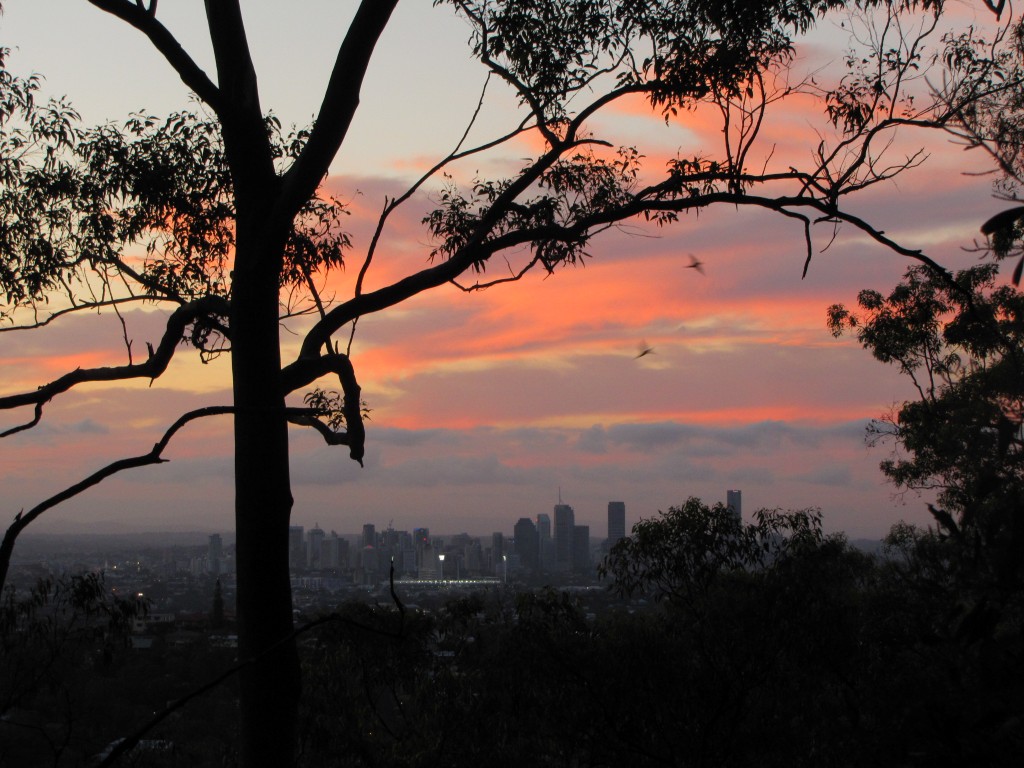
Sunset in Winter
Bush poetry of Dennis N. O'Brien
The amber glow as day begins to die
Behind a darkened hill that lies to west,
Where trees that silhouette against the sky
March on like lines of soldiers on its crest.
And where the amber meets the fading blue
And tinges it with golden streaming light,
With painted colours these last rays imbue
The western sky, before the fall of night.
Saturday, 14 April 2012
A Skink and waterfalls at Springbrook
The weather here in Queensland at Easter was absolutely glorious, we had a wonderful camping trip. We were staying near the Channon, a lovely place, but were really keen to visit Springbrook National Park - although not particularly near where we were staying (in fact, closer to home, oops!!). Anyhow, it was a really stunning drive across the hills, passing by no less than 3 national parks: Mt Jerusalem, Mt Warning (Wollumbin) and Lamington (Binna Burra section), as well as quaint villages like Uki, and the infamous Nimbin.
Perhaps it was the drop of rain we had during the night that meant the waterfalls were in full flow! We decided to do the Twin Falls circuit walk, which loops above, below and behind several beautiful falls. This is the Twin Falls waterfall, below, that we walked behind (second image)! How I wish I had been wearing my swimmers for a dip in the beautiful pool below the falls.


A couple of other lovely waterfalls we could only see the top of, but I got some nice pictures nonetheless. The first is a picture of the view out across the treetops taken from a little bridge crossing the top of Blackfellow falls (my favourite viewpoint of the day), the second is taken at the top of Goomoolahrah falls (meaning Big Waterfall in the language of the Yugambeh people of this region) - a short drive away.

 The reason I know the Yugambeh aboriginal word is that we also came across a noticeboard, explaining all the aboriginal place names around Springbrook, very interesting!
 We also encountered some wildlife, despite the tracks being rather busy. We were lucky enough to see a Land Mullet, Egernia major, which is a very large Skink - in fact the largest Skink species in the world! Apparently they can be quite shy despite their size, so Im very pleased to have manged to get a quick snap of one before he disappeared into the bush.

Perhaps it was the drop of rain we had during the night that meant the waterfalls were in full flow! We decided to do the Twin Falls circuit walk, which loops above, below and behind several beautiful falls. This is the Twin Falls waterfall, below, that we walked behind (second image)! How I wish I had been wearing my swimmers for a dip in the beautiful pool below the falls.


A couple of other lovely waterfalls we could only see the top of, but I got some nice pictures nonetheless. The first is a picture of the view out across the treetops taken from a little bridge crossing the top of Blackfellow falls (my favourite viewpoint of the day), the second is taken at the top of Goomoolahrah falls (meaning Big Waterfall in the language of the Yugambeh people of this region) - a short drive away.


Friday, 23 March 2012
Brisbane's Koala controversy

So, how many Koalas live in Brisbane? Are numbers still declining, or stable? These questions are at the heart of continuing controversy over the status of koala populations around Brisbane. Due to its iconic status in Australia, koala population declines get more airtime in the press than most of the other species facing serious population declines as Australia rapidly urbanises. Such airtime inevitably increases close to the forthcoming state election! However, without independent, up-to-date, scientifically collected data, the article states that conservationists claim they are fighting a loosing battle against figures that are 'fudged'. The most recent state government report (2010) with a survey of the population in this regions was compiled by DERM (Department of Environment and Resource Management). As Koala numbers are now reported to be low but the margin of error in the government survey remains high, it is increasingly difficult to statistically prove a decline without better survey methods that reduce the uncertainty. With such uncertainty in the 2010 report it is simply inconclusive about whether the decline continues or not and open to interpretation by politicians, such as state Environment Minister Vicki Darling, claiming that this means they have stabilised without any proof. Better census methods seem to be urgently required.
Populations on the Koala Coast are now somewhere around 1/3 of the population of 20 years ago - but the sustainability of the population is not mentioned in the DERM report. The 'Australian Koala Foundation' (AKF) and Australian Research Council are funding scientists at the University of Queensland and DERM to work on this question, and they have been examining the impacts of multiple threats (dog attacks, vehicle collisions and disease) on the koalas in this region and the impact this is likely to be having on the sustainability of the population. Their conclusion is that the population will continue to decline unless there is intervention that can drastically reduce more than one of these threats. With such rapid urbanization in Brisbane the threats look set to increase, not decline, a chilling thought.
Tuesday, 20 March 2012
A Liebster award

Many thanks to Martin of The House of Fran_Mart for nominating my blog for a Liebster Blog award! ( This is a German word, which online searches translate as 'Sweetheart". A better idiomatic translation would seem to be “favourite". )
Receiving the award involves certain obligations: I had to decide on five blogs, each with fewer than 220 followers, to pass it on to. The idea is to bring attention to these small blogs who deserve more notice.
AND THE WINNERS ARE …
In no particular order …- The Blogfolio of Edd Cross - quite literally my 'liebster' blog, a wonderfully imaginative and eclectic mix of illustrations, often inspired by Australian wildlife.
- Tony's photo blog - some beautiful photos of Australian nature that inspire my own humble efforts, taken by a fellow ex-pat pom! (and always some interesting skywatch contributions)
- Snail's Eye View - a lovely, personal perspective on the nature of the Atherton Tablelands
- Daintree Valley - a blog run by a guesthouse in Daintree village, whose owners clearly have a genuine passion for their beautiful surrounds. One day I will visit (and it will feel strangely familiar!).
- Bush and Beach - now I have moved to Brisbane we are on the same blog territory and Leanne's blog will be an inspiration for my local adventures.
- Thank the giver and link back to the blogger who gave it to you (thank you, Martin!).
- Reveal the five blogs you have chosen and let them know by leaving a comment on their blog.
- Copy and paste the award onto your blog (see above).
- Request the people you have chosen to receive the award pass it on to their favourite bloggers.
Subscribe to:
Posts (Atom)