Sunday, 3 October 2010

More snaps of the baby wattlebirds

I couldn't resist going back to the gardens again on Friday to see if I could get some better pictures of the baby red wattlebirds.  I had gone on Thursday without my camera and stood close by as one of the parents visited the nest and fed the babies, I was hoping I could catch that with my camera!  I managed to zoom in and the babies were looking over the top of the nest this time so I could see their little beady eyes, however when mummy or daddy arrived there were just too many leaves in the way - you might be able to make out the yellow on the parent's chest in the last picture below?!
 I will go back again next week and have another go, I guess they will be a little bigger then too!  Lots of lovely flowers are all around the gardens, as well as the wattle of course.  I took a picture of a very pretty yellow flower called Goodia lotifolia - that sounds a bit like some Latin I made up myself!  This bush has a number of common names, the one on the label in the gardens was 'golden tip', which seemed very apt.  Below that is Grevillea corrugata, a relatively rare Grevillea, endemic to a small region in South-western Australia near Bindoon.  Philotheca 'poorinda', an unusual pretty pink cross between an Eriostemon and a Philotheca, in the background. 
 I also managed to get a nice shot of one of my favourite birds, a cute little Eastern Yellow Robin.  I like them as they have a similar character to the Robin 'red-breast' we have in the UK: quite inquisitive and friendly, they like to sit and look at you for a while on a branch - also great for taking a photo too! However, the Eastern Yellow Robin is of the genus Eopsaltria, meaning 'dawn singer', unrelated to the European red robin, related instead to many tropical and Australian passerines including pardalotes, Fairy-wrens and honeyeaters. 

Wednesday, 29 September 2010

What a load of Wattle!

I have been away on various trips lately and so it has taken a while since my last blog for me to get around to photographing the glorious yellow blooms of the Wattle.  They are simply bursting like rays of bright sunshine across the gardens, Spring is here!  The Golden Wattle, Acacia pycnantha is Australia's floral emblem - you can read about its significance on the ANBG website here.  I really don't remember the Wattle looking so amazing last year, as a pom I see it as Australia's answer to the Daffodil. 


So beautiful.  As I was wandering around taking Wattle pictures I heard a strange rasping noise I'd never heard before coming from a Banksia bush.  I looked hard and worked out where the noise was coming from - a Red Wattlebird's nest!  One of the parents was nearby (not sure if it was Mum or Dad - both parents feed the young).  I didn't want to disturb the nest or frighten the chicks so I couldn't get my camera very close and used the zoom, but the nest was quite well concealed in the Banksia, despite being at eye-level!  Here are a couple of shots of the chicks (you will have to look hard amongst the leaves in the first photo) and parent on the lookout up in a tree. 


Nearby a kangaroo was grazing, he has a very friendly sort of face (not sure if it is a he but it seemed like a 'he' - no joey in sight anyhow!). 


As I was leaving the gardens I came across a new bird I hadn't seen before, always very exciting particularly in these gardens that I visit so often.  It was a Satin Bowerbird Ptilonorhynchus violaceus, and a fully mature male at that - young males may begin to acquire their adult plumage in their fifth year and are not fully 'attired' until they are seven.  His colour was gorgeous, the most beautiful deep shiny dark blue all over.  He was a bit elusive however, I spent a while chasing him round some bushes trying to get a clear shot but he wasn't co-operating and I had to get back to the office... so this is the best I managed!   Hopefully I will see him again and be able to get a better picture next time. 

Monday, 16 August 2010

A twilight adventure

I have been waiting a year for this evening.  Once a year the botanic garden opens the gates at night to a handful of lucky visitors as part of National Science Week.  Last year I was unlucky and didn't sign up in time, so this year I put my name down and my partner Edd's good and early!  Although today was a bit wet and windy, by this evening the sky had cleared and the stars were out.  It was cold, probably close to zero, but we had wrapped up warm and were armed with torches.  We split into groups of 8, we were with a guide called Will.  As we set off along the rainforest walk it really felt like an adventure. 
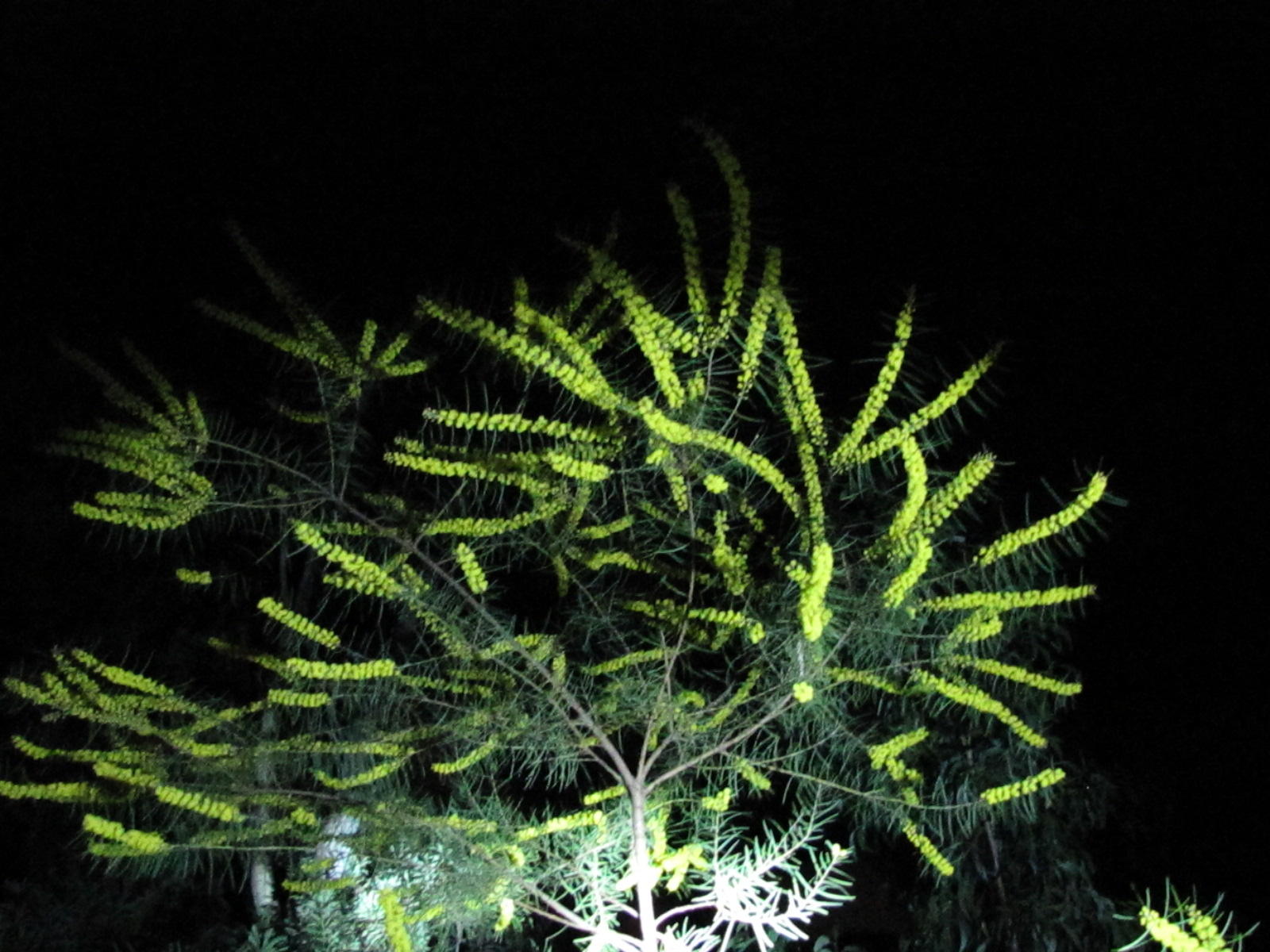
The plants made fantastic shapes in the spotlight.  Here an ancient species, Bunya Pine Araucaria bidwillii is lit dramatically from below.   Will, our guide, pointed this out as a special tree, of the genus Araucaria.  The 'nuts' are edible and valued by aboriginal people.  Another ancient species, the famous Wollemi pine Wollemia nobilis, is glowing in the spotlight below.
Next came the highlight of the evening.  we were wandering past the Acacias towards the Eucalypt lawn when one of the group were startled by a large bird sitting right by the path.  The bird flew up into a tree and there he sat for us to watch him for a while. It was a nocturnal bird I hadn't seen in the wild before and I was very excited to see one as it is such a very unique being - the Tawny Frogmouth Podargus strigoidesWill switched to a red spotlight so as not to bother the bird too much and I was able to get some lovely shots. 


 The Tawny Frogmouth is a nocturnal bird, but it is not an owl.  You can see why it is called a frogmouth, it has a strange frog-like beak you can make out quite well in the first picture. 

After that we came across a little mob of Kangaroos on the Eucalypt Lawn.  A couple of them were mothers with little joeys in their pouches.  I had no idea there were so many Kangaroos in the gardens, Ive only ever seen one or two at a time so I thought that was all of them!
We carried on through the gardens, looking at plenty of acacia which are coming into flower - it won't be long before the gardens are ablaze with their yellow blooms.  The moon looked down on us as we passed under Eucaplytus trees, we learnt how to tell where South is from the Southern Cross, tasted some native plums, smelt some Lemon Myrtle leaves and all the while we were trying to spot the elusive little Sugar Glider Petaurus breviceps which are extremely cute little things we were really hoping to see. 


By this time it was getting late and so we headed towards our hot chocolate and biscuits.  Just before we arrived we spied a Brush-tailed Possum Trichosurus vulpecula up above!  With the red spotlight it was possible to get a nice picture without the red eyes I usually get with my flash. 


So, did we see an elusive Sugar Glider?  Yes, we did!! We heard a noise just before we went for our hot chocolates and a sharp-eyed member of our group spotted him.  We couldn't get close enough for a picture as he was high in a tree, he looked like a tiny possum from a distance.  Here is a link to an image someone else has taken of one of these cute little things, though maybe it is an image from the USA, as I believe you can keep them as pets over there (certainly not in Australia).  I was so happy to see all the creatures I had hoped to see tonight, it was really worth a year to wait, I just wish they ran these events more often.  There are two more tours on this week, so if you are free on Thursday or Friday evening sign up!

Wednesday, 4 August 2010

Baby Kookaburra!

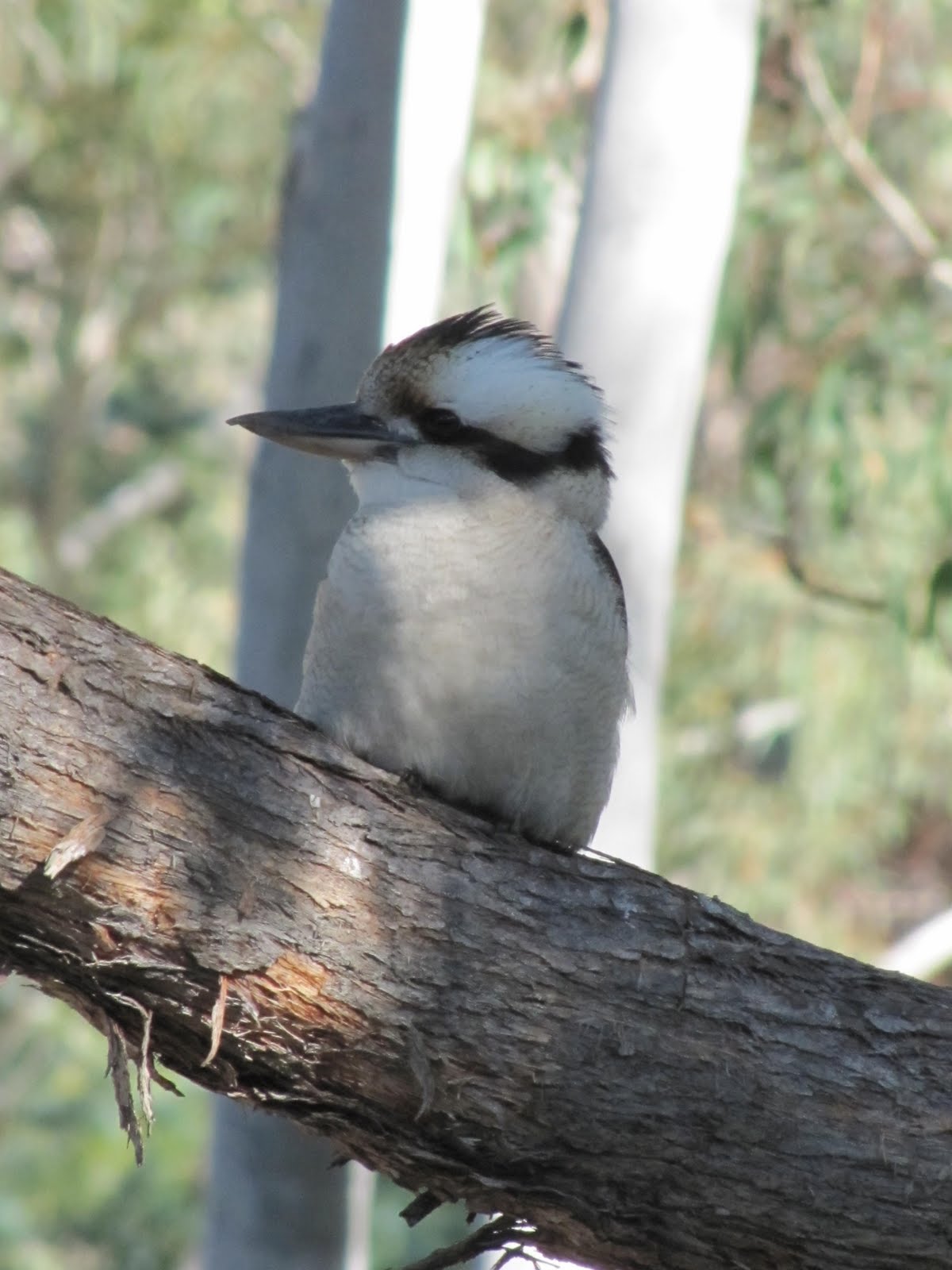
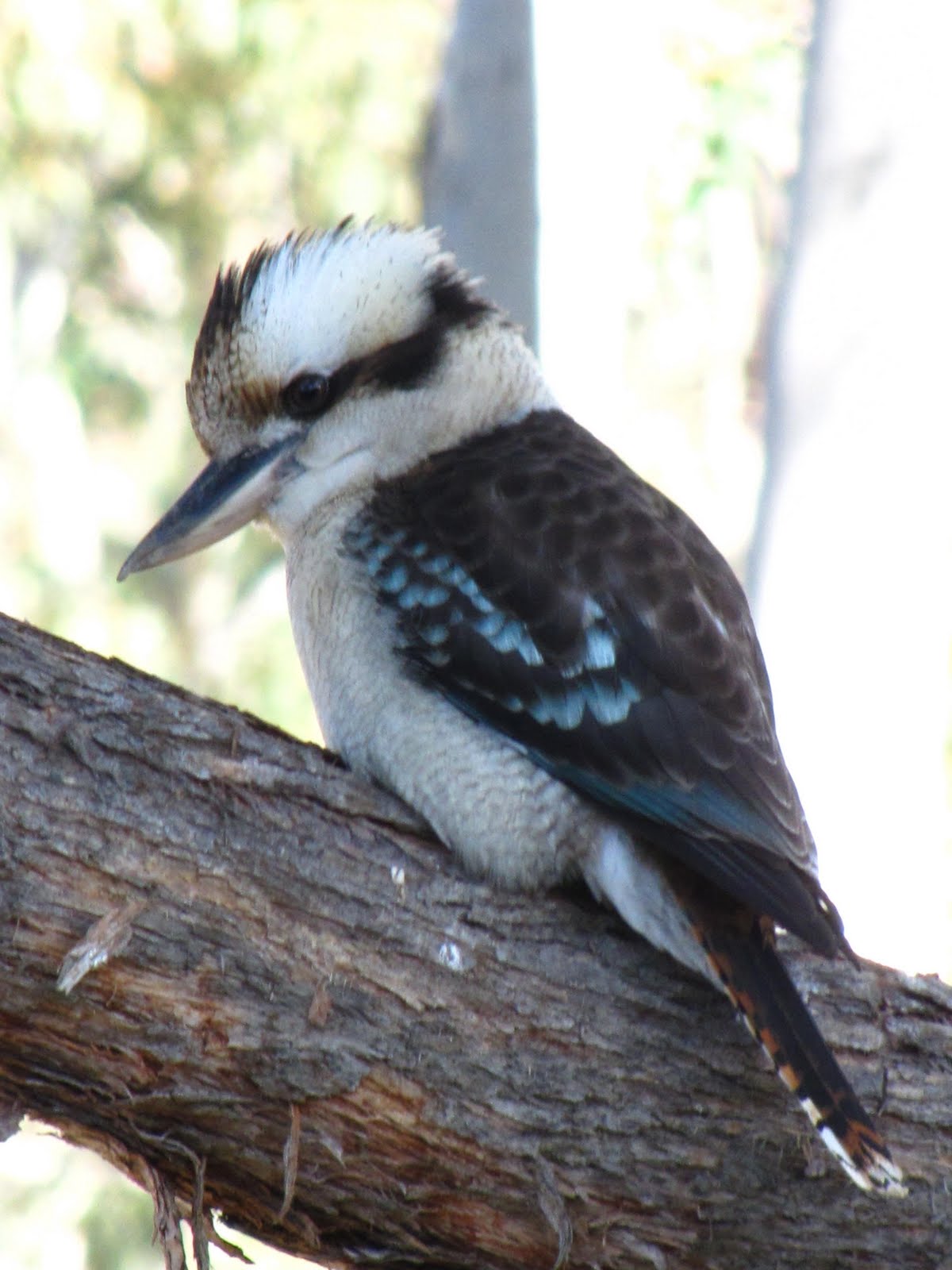
Before I even made to the gardens today I took a look out of my office window and saw this lovely little Kookaburra Dacelo novaeguineae sitting in the trees close by.  I think he might be a baby, he is so fluffy!  Although not technically in the gardens I couldn't resist posting a few of the nice shots I took, it was great having him at eye-level (my office is on the 1st floor)!


There have been 3 Kookaburras flying about lately, they seemed to be getting quite territorial as they have been 'laughing' a lot!  In the last picture you can see some of the yellow of the Acacia that is starting to bloom in the background.  A quick trip to the gardens after that, I spied a little female Superb fairy-wren so tried (and failed) to get a good picture - the best effort is below as she was stretching up and looking towards me! 
A really stunning flower I hadn't seen before was in bloom and was attracting lots of New Holland Honeyeaters to feed on the nectar.  It is Calothamnus rupestris in the family Myrtaceae, or 'Mouse Ears' as it is commonly known! According to the link above, it is endemic to Western Australia in a relatively small region around Perth. 

Thursday, 1 July 2010

Winter blooms and a Yellow Robin

Winter has definitely arrived in Canberra now, each morning is crisp and frosty.  However, there are still some flowers hanging on in the gardens, in fact, some are just coming into bloom!  In particular, some of the Acacias or Wattles are starting to bud, and some even to flower. 
Unfortunately there was no label on this Acacia, it looked magical bursting into bloom whilst much of the garden appears to be sleeping.  This Snowy River Wattle Acacia boormanii was at an earlier stage, with buds appearing.
The acacia foliage can differ quite strikingly, looking like very different plants to the non-expert like me.  A number of Acacia develop modified flat leaf-like structures called phyllodes (which are simply flattened stems).  A few species lack true leaves or phyllodes altogether and in these plants cladodes (which are simply modified stems) function as the leaves.  Here is an example of one such Acacia with phyllodes, the creeping shrub-like Acacia pravissima or Kuranga cascade as it is called in the gardens, though may also be called Oven(s) Wattle, Wedge-leaf Wattle or Tumut Wattle. 
This is an example of one with cladodes (though I don't know the name of it I'm afraid)
There are some other bursts of colour around the garden too, including these beautiful bell-like red flowers I found in the Sydney region flora section, as well as these gorgeous tiny little purple flowers that I think might possibly be a kind of Shaggy Pea Fabaceae Podolobium?!  It resembles the Hovea linearis but was growing very close to the ground with highly clustered flowers.
 
As I was photographing the suspected Shaggy Peas I heard a noise and looked up to see an extremely cute and fluffy Eastern Yellow Robin watching me.  I hoped he would stay long enough for a photo and he did - in fact I got a couple of great photos of him I'm really proud of, what a cutie!

Sunday, 20 June 2010

Trees and a dinosaur

Its been a little while since my last post so I'm playing a bit of catch-up.  I had a friend visit from the UK so was occupied showing him the mighty sights of Canberra!  Of course, the Botanic Gardens were first on the list and I took plenty of pictures, only I've not had time to write a blog until now (as then we went off for a few days to Byron Bay - great place!)

So, with a visitor to impress I decided to head for probably the most exciting tree in the garden - the Wollemi Pine Wollemia nobilis, the 'dinosaur' tree.  I've just finished reading the book about "the incredible discovery of a living fossil from the age of the dinosaurs" - the Wollemi Pine by James Woodford, which is a great read (I also loved his book 'The Secret Life of Wombats'), so now I know a bit about how amazing this tree is.  Not only is it incredible that the Wollemi pine has survived in such improbable isolation across millennia, only to be discovered in the mid-90s (and only recently available commercially), but its identical genes have baffled scientists, it has unique bark and leaves, even a fungus found on the leaves of some of the wild trees has been found to produce an anti-cancer agent - amazing. To this day, the location of the hidden valley in the Wollemi wilderness near Sydney where the relic trees were found is a secret.
As I proudly showed the tree to my buddy from the UK he smiled and said he had seen one before - in Kew gardens in London!  However, there it is kept in a cage for protection but here in Canberra this amazing tree is just standing quietly beside a side path through the connifer section. 

There are a lot of other fascinating trees in the gardens too, of course.  There is even an aboriginal trail that tells you the aboriginal uses for plants and trees, from which I learnt about the how the aborigines used the hard wood of the Cassaurina or she-oak to make boomerangs, one she-oak boomerang has been found that is 10,000 years old in Wyrie Swamp, South Australia!  Young shoots can be chewed to quench thirst. 

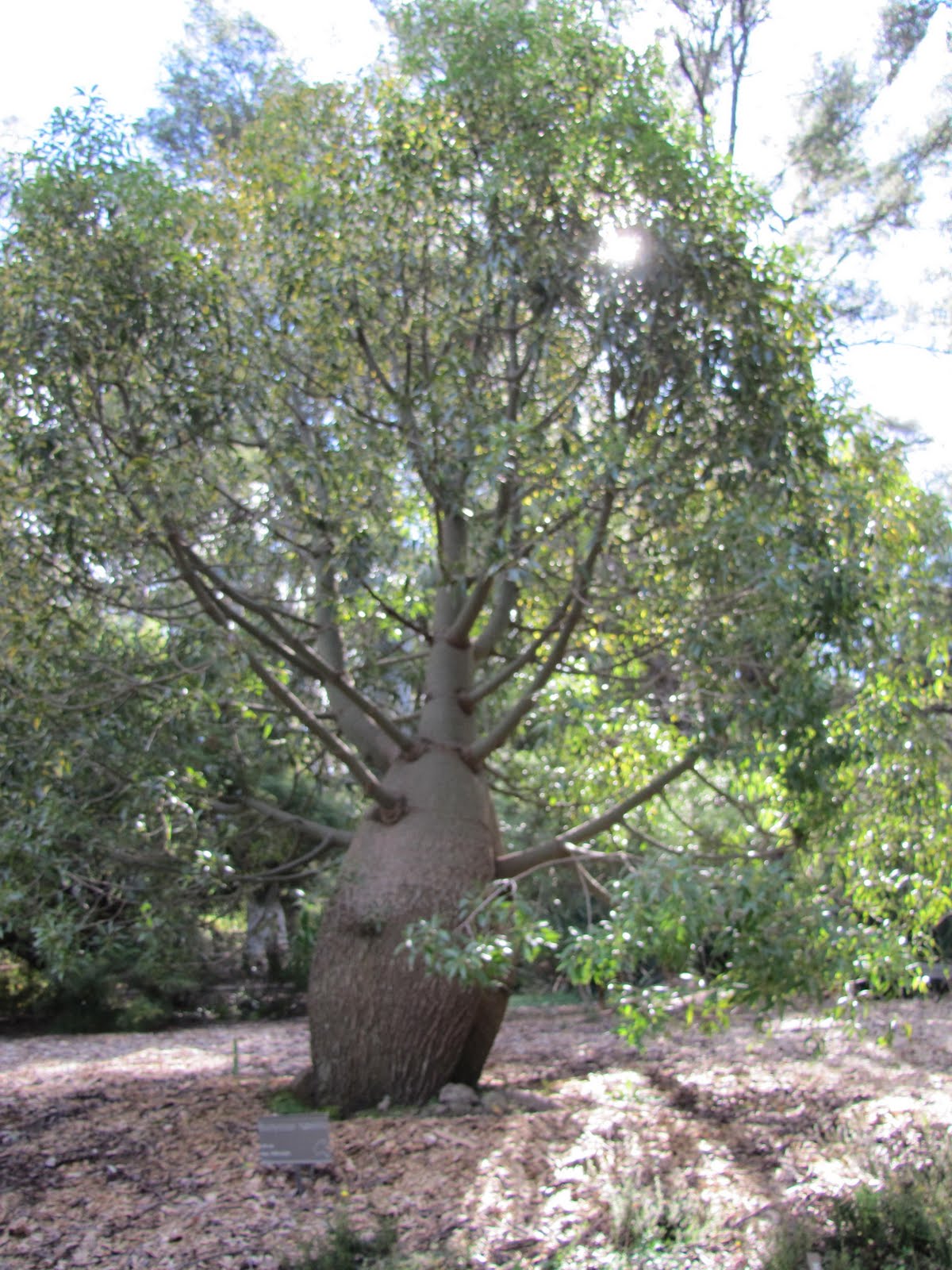
The Bottle tree Brachychiton rupestris is a fascinating tree which hails from Queensland, not only for its very funky shape but also because the wood contains a nutritious jelly which can be obtained to drink by making a hole in the trunk (which can be up to 2m in diameter!). 

There are also hundreds of Eucalyptus trees in the garden, in particular the Brittle gum Eucalyptus mannifera which appears all around the gardens. 


The one above is interesting as a large branch has been chopped off so the inside of the tree can be seen.  Brittle gums are so-called as they may drop branches without warning (so perhaps this one was removed before it dropped), makes me a little more nervous wandering round the gardens now I know that!  This particular tree is also interesting as it is known as the 'Pryor tree', in tribute to Lindsay Pryor who was instrumental in getting funding for the establishment of the gardens.  Below is a photo of the sign that tells more about this tree, including a photo which was taken when the tree had all its branches!

Wednesday, 2 June 2010

An iconic insect of the Australian bush

From my first day in Australia I have become familiar with certain sounds that you'd hear no-where else.  From the distinctive cry of the Pied Currawong Strepera graculina and the Australian Magpie Gymnorhina tibicen to the grating noise of the red wattlebird Anthochaera carunculata and of course the laugh of the Kookaburra Dacelo novaeguineae.   I have found some links to mp3s of these:
The ANBG has a few more calls of birds found in the gardens on its website here.

It is not just birds that make a distinctive noise in Australia, particularly in summer the bush is alive with the sound of insects - its that which really tells me (an Englishwoman) I'm somewhere 'foreign'!  King of these is the Cicada, which although not unique to Australia there are over 200 species of Cicada within Australia found in every corner of the country.  Over the summer we heard these very loudly, particularly when visiting Kangaroo Valley over Christmas where the noise they made was incredibly loud.

This is a sound file recorded in New Zealand of a Cicada - just imagine it multiplied by 1,000 and 10 x louder and you have the Australian bush in summer!

However, until now, I've not managed to see one of these large insects despite feeling surrounded by thousands at times.  At lunchtime I was walking down a less well-trod path in the gardens and at eye level I spotted a very strange looking insect, over 1 inch long.


 I quickly realised it was just a dry shell, the insect having undergone molt from the final nymphal instar to become an adult. The nymph would have been living underground then constructed an exit tunnel to the surface and emerged. Having climbed onto the tree where I found the shell (a wattle-leaved peppermint tree Eucalyptus acaciiformis) the nymph would have split open the shell and flown away, leaving the skin behind clinging to the tree bark like a ghost.  You can clearly see where the shell has been split in my photo.  Here is a film of this event that I have taken from Wikipedia, it looks like an alien!